f0fbd9ceb5164efcfad783cb491d62f8

by Zheping Huang and Gregor Stuart Hunter via Bloomberg

Activision Blizzard Inc. is facing a fierce backlash and calls for a boycott after a unit of the American game company punished a player for supporting Hong Kong’s protest movement, the latest cultural clash between the U.S. and China.

Blizzard Entertainment banned Ng Wai Chung, known as Blitzchung, from its Grandmasters esports competition for a year and withheld prize money he had already won after he used a slogan from Hong Kong’s pro-democracy movement. Players and fans around the world immediately responded with outrage over what they view as heavy-handed punishment and kowtowing to Chinese censorship. The topic erupted online, with #blizzardboycott trending on Twitter.

“I will never play Blizzard’s game from now on, unless they apologize to blitzchung and to HK people. Blizzard sucks,” one person wrote on a forum discussion thread called ‘Solidarity with Blitzchung, Censored by Blizzard.’

Hong Kong’s protests have sparked escalating clashes between Beijing and the rest of the world. The National Basketball Association was engulfed in controversy after the general manager of the Houston Rockets expressed support for the protesters, leading China’s broadcasters to pull NBA games and local companies to drop Rockets products. Apple Inc. was blasted by the Communist Party’s flagship newspaper for carrying an app and song embraced by the movement.

China’s Online Army Shows Foreign Brands Who’s in Charge

The Blizzard incident began when Ng — dressed in a gas mask and goggles in defiance of authorities’ ban on face masks — used the phrase “Liberate Hong Kong, revolution of our age!” during a post-match interview. Blizzard, developer of games like World of Warcraft and Hearthstone, said in a statement it instituted the ban to “prevent similar incidents” in the future. On the China microblogging site Weibo, Blizzard’s statement in Chinese was: “We will, as always, resolutely safeguard the country’s dignity.”

The blowback was immediate. In South Korea, Blizzard became a top trending subject on Twitter with people saying the company “prioritizes money over human rights” and that it is “crazy” and “‘disappointing.” In the U.S., an influential former Blizzard employee, Mark Kern, rebuked the company.

“You screwed up and traded your players in for dollars,” he tweeted. “There is keeping politics out of games, then there is grand standing to appease the Chinese Communist Party.”

Contacted for comment, Activision Blizzard reiterated in a statement plans to enforce its established rules of conduct: “While we stand by one’s right to express individual thoughts and opinions, players and other participants that elect to participate in our esports competitions must abide by the official competition rules.”

Activision Blizzard joins a number of international companies embroiled in controversy around free speech linked to China. Luxury brands like Versace, Coach and Givenchy have all fallen foul of Beijing’s demands to refer to both Hong Kong and Taiwan as parts of its territory and not suggest they are independent nations. During the summer, China also requested more than 40 foreign airlines stop referring to China, Hong Kong and Taiwan as separate countries.

“As you know, there are serious protests in my country now,” Ng said in a statement to gaming blog Inven Global. “My call on stream was just another form of participation of the protest that I wish to grab more attention.”

Activision Blizzard has tie-ups with Chinese gaming houses Tencent Holdings Ltd. and NetEase Inc. to distribute — and in some cases co-develop — new entries in beloved franchises like Call of Duty and Diablo in the world’s biggest video game market and beyond.

One player explained how much they enjoyed playing Blizzard’s World of Warcraft, but would be stepping back from it and joining the boycott.

“I hit level 45 tonight so when I read the news I was extremely sad,” the person wrote. “I can put up with a lot, but if it’s someone’s freedom or my money, I will gladly give up my favorite game so that others can have the same freedoms I enjoy.”

Visit us at https://www.blackdollindustries.com/
03d4a0580db024bc7fb16709e44de10f

by Todd Spangler via Variety

PlayStation 5, the official name of the next generation of Sony’s game console, will launch next year ahead of the 2020 holiday-shopping season, the company announced Tuesday.

But Sony is still keeping many details of the PS5 under wraps, including pricing and new game titles queued up for the more-powerful console. Sony released the first official details for the next-gen PlayStation in April.

Jim Ryan, president and CEO of Sony Interactive Entertainment, in a blog post announcing the 2020 target ship date, called out two new changes with the PlayStation 5 controller.

First, the PS5 controller will adopt haptic feedback to replace the “rumble” technology found in recent-generation consoles. “With haptics, you truly feel a broader range of feedback, so crashing into a wall in a race car feels much different than making a tackle on the football field,” Ryan wrote.

The second feature is what Sony calls “adaptive triggers,” which have been incorporated into the trigger buttons (L2/R2). Developers can program the resistance of the triggers so that, for example, players feel the tactile sensation of drawing a bow and arrow or accelerating an off-road vehicle through rocky terrain, according to Ryan. Sony has provided early versions of the new PS5 controller to game developers.

The PS5 will include ray-tracing support and have a high-speed solid-state drive (SSD) for improved performance. Sony provided Wired with a first look at the PlayStation 5 controllers; in the article, Sony clarified that the console will include ray-tracing acceleration in the GPU hardware and broadly described the PS5’s new real-time homescreen user interface that will show, for example, which missions and rewards are available for single-player games and active activities players can join in multiplayer games.

The PS5 will supersede the PlayStation 4, which was first released in North America six years ago. For Sony’s most recent fiscal year (ended in March) the Sony Interactive Entertainment unit generated about $20.8 billion in revenue (up 20% year over year) and $2.9 billion in operating profit — it’s the Japanese conglomerate’s biggest and most profitable business.

Sony isn’t done with the PS4, though, as Ryan pointed out. Upcoming titles for the PlayStation 4 include “Death Stranding,” “The Last of Us Part II” and “Ghost of Tsushima.”

Visit us at https://www.blackdollindustries.com/
And yes, it’s drivable, with an LS1 V8 from a Corvette

3e48f5e05e9317f7730f722067aaccd7

by Tony Markovich via Auto Blog

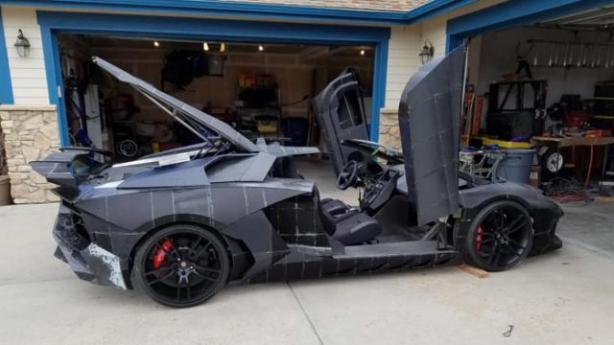
Sterling Backus’s son only had one question after he drove a Lamborghini Aventador in the XBOX video game Forza: Can we build one? Most dads would respond with a chuckle and some quip about winning the lottery. But not Backus, whose day job is laser physicist. Backus responded, “Sure,” and he meant it. As of this week, the replica is capable of driving under its own power.

Backus, the chief scientific officer at KMLabs in Boulder, Colorado, and his 11-year-old son dubbed the project “Interceptor,” and the build has a budget of about $20,000. Backus hand-built the steel chassis and pulled an LS1 V8 from a Corvette for power. He found the panel layouts through online design community GrabCAD, and then he modified them for 3D printing.

But he ran into a problem: The 3D-printed plastic would melt in the sun. So, he decided to incorporate carbon-fiber encapsulation (shown below), in which he wraps the parts and covers them in epoxy. Piece by piece, he assembled the shape of the supercar using a Creality CR-10 105 desktop 3D printer that he got for about $900 from Amazon. The front brake air intake alone is said to have taken 52 hours to complete. Additional cool features include a gated shifter, functioning lights, and scissor doors.

One of the fun aspects of the whole story is that Backus admits he had some learning to do when it came to the art form of additive engineering. So, he turned to the same place everybody else goes these days: YouTube. The physicist joked that he went to YouTube University and learned by watching videos.

With the end of the project in sight, Backus says he wants the final product to serve as an educational tool for Science Technology, Engineering, Art, and Mathematics (STEAM) programs.

“The intent is to take the car to local schools to show kids how cool technology can be,” the project’s Facebook page says.

In the words of Jesse Pinkman, “YEAH SCIENCE!”

Visit us at https://www.blackdollindustries.com/

EA

by Saqib Mansoor via Segment Next

Electronic Arts (EA) has been sent a legal notice to appear in the United States district court of Texas over at least two counts of patent infringement.

The lawsuit was filed by Stone Interactive Ventures (SIV) last month, where the plaintiff noted that it currently holds the rights to US7593864B2 and US8516473B2 in the United States Patent and Trademark Office. EA is required by law to obtain a license to operate on the said patents, which the publishing giant decided not to. Hence, EA must either obtain a license from the limited liability company — pay mounting royalties — or cease its ongoing infringement, at least that’s what the lawsuit alleges.

The patents in question are generally related to management and ownership of virtual properties, and distribution and sale of program objects. Apex Legends and Anthem were both quoted as examples through which EA continues to violate trademark law — specifically, through their in-game currencies.

apex-legends-keyart

Apex Legends and Anthem have Apex Coins and Anthem Shards respectively that can be used to purchase cosmetics from an in-game store to customize the appearance of weapons and characters. SIV argued that the players are also infringing on the same patents by obtaining virtual properties through these virtual currencies.

In addition, the virtual properties can further be transferred or shared in-game, which is a violation of “purchase and ownership of property rights” as mentioned in the patent bylaws.

The lawsuit failed to mention any sum that the plaintiff wants in damages, leaving it to the court of Texas should a ruling be cast in SIV’s favor.

The world of patent infringement is a messy and complicated one. SIV, from what information is available, is basically a patent assertion entity that purchases patents to profit, not to use. Also, SIV has made claims on behalf of Intellectual Ventures Assets (IVA), the rightful assignee of the patents mentioned in the lawsuit, casting SIV as a possible shell company to duel these legal matters. Making it even worse is that IVA owns about 40,000 patents with no intention of using them anytime soon. It’s essentially a threat to aspiring entrepreneurs and large-scale technology companies.

Anthem

EA, while the defendant in this case, has also been securing patents that can drive microtransactions in the future. More recently, the publishing giant was spotted to have obtained a patent through an asset acquisition for a system that creates a sense of urgency to make in-game purchases as soon as possible.

The reason being that the virtual items decrease in value over time based on the number of purchases made. Hence, if players want to reap maximum benefits, they will want to be the first ones to make the purchase — a kind of day-one microtransactions.

EA also patented a technology that fiddles with matchmaking. Such a system can observe player-behavior (skill, experience, sportsmanship, and other preferences) before pitting them against each other.

By matching a novice against an experienced player, the system would basically be encouraging the novice to emulate the decked-out player by purchasing items being used by them. Hence, pushing microtransactions through enticement and a false perception of superiority, something that many other game publishers besides EA are gunning for as well.

Visit us at https://www.blackdollindustries.com/

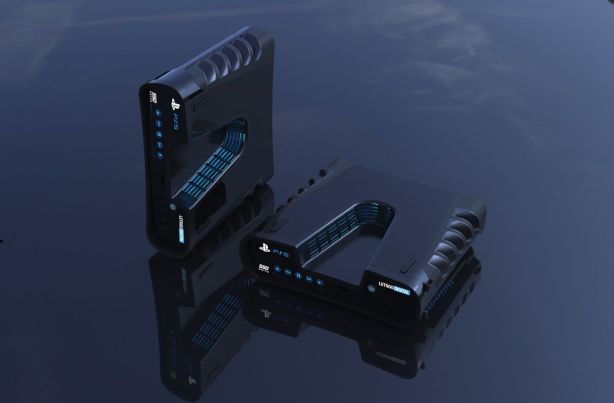
sony-ps5-dev-kit-renders-patent-1

by Chris Smith via BGR News

The high-resolution render above shows us what a PS5 dev console looks like, and it was created using a newly discovered Sony design patent. The reason renders like this exist in the first place is that a developer accidentally confirmed the design on Twitter, and then proceeded to delete the message and his entire account. It turns out that a different developer with access to both the PlayStation 5 and Xbox 2 (Project Scarlett) has been sharing images of the PS5 dev box for a while now, as well as additional details about the upcoming next-generation Sony and Microsoft consoles.

Release date and specs

The leaker told Gizmodo in a series of emails that the blog was right with the assumption that AMD was slow to get ray tracing support on Navi, and that’s why both consoles couldn’t launch before 2020, in spite of both Sony and Microsoft confirming the main specs for each product. “Correct that AMD Navi v late,” the tipster said.

The person also said that the PS5 design above is codenamed Prospero, and it was delivered to developers early this summer. Gizmodo explained that Prospero is a character who appears in William Shakespeare’s The Tempest. Ariel and Gonzalo are other characters from the play, which are coincidentally the codenames that AMD may have used to hide its brand new console parts from the public. Ariel and Gonzalo were associated with new AMD semi-custom chips for gaming consoles, or Accelerated Processing Units (APU). A GPU called Oberon was also discovered earlier this year. The Shakespearian inspiration also suggests all these parts are made for next year’s consoles.

The tipster revealed that the future console will have “the greatest compute jump in any console,” without revealing any specific details.

4f517f56337ca4fc60e4668b18a53712

PS5 design

More interesting is the fact that the tipster provided highly altered images that showed a console like the one in the render above, but it didn’t have any markings that could help Sony and Microsoft identify the source:

The best photo our tipster sent isn’t much—a 33.5Kb gif that is just 238 pixels by 144 pixels. It’s been cropped and downgraded as if to remove any possible identifying details. Suffice it to say that from what we can see, the details in the photo appear identical to the [patent] registration illustrations. […]

What immediately catches your eye is that this device has a two-tone color job, much like PS4 developer boxes before. Much of what we see is covered in a shiny silver finish that reflects the garish overhead lights illuminating it. The parts not covered in the silver finish are covered in black plastic. The portion visible includes those five gill-like vents and that big V-shaped divot.

In other words, it sure looks like Sony designed a custom PS5 case that’s pretty complex to be used on a dev kit and then never again. However, that doesn’t mean it’s the design Sony will use for the new PlayStation 5 that will be released last year.

Xbox Scarlett camera
On top of all that, the report explains that both consoles should have built-in user-facing cameras to facilitate live game streaming. The PS5 dev kit featured older camera tech that will probably be replaced on the final product. But the Microsoft Xbox Scarlett kit comes with a 4K camera that’s able to deliver a two-frame latency between what’s recorded and what appears on the stream. Microsoft (and Sony) seem to be well aware of the increased popularity of game streaming, and the next-gen consoles might pack great hardware so gamers don’t need to buy third-party cameras to stream.

UPDATE: A Microsoft spokesperson denied to Gizmodo that any Scarlett camera technology is in development and that such camera tech had been delivered to developers.

Visit us at https://www.blackdollindustries.com/

Call-of-Duty-Mobile-Controller-Support-1185241

CALL of Duty Mobile Controller Support is a much-wanted feature for many gamers hoping to get the most out of the new Android and iOS launch.

by Gary Jones via Express

Fans have discovered today that major changes have been made to Call of Duty Mobile Controller Support.

The new Android and iOS title only just launched, with a bumpy 24hrs seeing a lot of server problems.

Fans were prepared for this but might not have quite so ready for some other changes that have been made.

According to Activision, a new Call of Duty Mobile update has been released, which has changed some core settings.

And this reportedly includes COD Mobile Controller Support on Android and iOS devices.

Fans have been throwing questions at the Activision Support team on Twitter, who have finally provided an answer.

And it appears that Controller Support has now been removed from the game, following the game’s launch earlier on October 1.

“Hello there, thank you for contacting Spec Ops support,” The Activision Support team confirmed.

“Unfortunately, this is no longer supported after the most recent update. I would be more than happy to help.”

No detailed has been given for the removal of this feature or if it might be a temporary measure.

Fans will be hoping for its return as it’s become quite a favourite feature on other mobile games.

Those with a PS4 controller would have a pretty easy time linking it to their phone using BlueTooth.

But until we hear more on the subject, it’s unclear if controllers will be back in play anytime soon.

The use of controller can provide players with an advantage over others, and this might be why the feature was removed.

If it is brought back, there is a good chance that Tencent and Activision will look to limit matchmaking.

This would make it possible for gamers with controllers to play against each other on a level playing field.

One user commented on today’s news by pointing out: “Mobile gaming will never be taken seriously if they can’t get this right.

“It’s not comfortable to play hands only, and if you’re a big unit like me, with bear hands, too much of the screen is obscured, and carpal tunnel is going to kick in.”

Another adds: “Completely agree, mobile games can be super fun but unfortunately the controls are clunky and awkward.”

“I get a controller “defeats the purpose” however there’s just some mobile games you want to play comfortably and some aren’t even on big consoles or PC.”

While today’s roll out may have proved a bumpy ride for many fans, there is no reason to believe this won’t improve in the weeks to come.

During a roundtable discussion with the dev team in July, they were also asked whether a release on the Nintendo Switch would be a possibility in the future.

And it’s easy to see why, providing Activision with a way to get a COD game onto the popular handheld console without downgrading the likes of Modern Warfare.

“Right now, we are completely focused on the mobile side,” Chris Plummer, VP of mobile for Activision, told the table.”

“I mean like Android and iOS, and making sure that’s the best possible experience that you can pull out of your pocket and play whenever you want.”

“…we would consider anything, I guess, but right now our priority and sole focus is iOS and Android.”

So while it sounds like a Nintendo Switch port is unlikely in 2019, plenty of dev support is in place for the current version of the game.

Visit us at https://www.blackdollindustries.com/
civilization-vi-main-art

by Just Lunning via Bleeding Cool

After appearing on PC, Nintendo Switch and iPad, Civilization VI advances to the only territories it has left to conquer: PlayStation 4 and Xbox One.

It was announced today that the acclaimed simulation game, Civilization VI would be launching on PS4 and Xbox One this November. Although the port is showing up late, as Civilization VI originally launched in 2016, it’s certainly not coming empty-handed.  PS4 users get a free copy of the Nubia and Khmer and Indonesia Scenario pack. This same pack will be available on Xbox One as a separate purchase.

Civilization VI’s two expansion packs: Rise and Fall expansion, Gathering Storm expansion will be available in a bundle sold separately from the main game for $49.99 at launch. That bundle will also come packaged with 18 additional leaders. The bundle is expected to be made available on Nintendo Switch as well.

Civilization VI will launch for PS4 and Xbox One on November 22, 2019. For eager beavers, it’s currently available on Nintendo Switch, iPad, and PC.

Visit us at https://www.blackdollindustries.com/

3ba3e590-acd1-11e9-bfe7-33959e5f25ae

by Mike Bebernes via Yahoo News 360

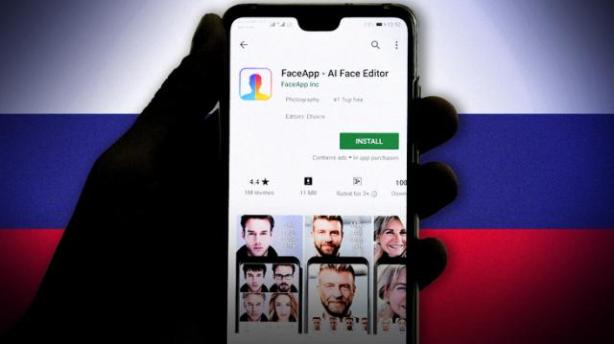
What’s happening: Anyone who used a social media site last week saw the images — photo after photo of faces that had been digitally altered to look older or younger or with different hair color. The images were created by FaceApp, an app that includes a variety of filters to change a person’s appearance.

FaceApp has been around for a couple years, but recently saw a surge in popularity. More than 100 million people have reportedly downloaded the app, including many celebrities.

Shortly after last week’s viral surge, experts were vocal about their privacy concerns. By agreeing to the app’s terms of service, users grant its creators “perpetual, irrevocable, nonexclusive, royalty-free, worldwide” ownership of images used in the app and the freedom to “use, reproduce, modify, adapt, publish [and] translate” them however they see fit.

There were also questions that the app might scrape data from a user’s mobile photo album, location, messages or other private information. These worries intensified when users learned that FaceApp’s development team is based in Russia. The Democratic National Committee warned presidential candidates not to use the app. Senate Minority Leader Chuck Schumer called on the FBI and the FTC to investigate its national security risks.

Why there’s debate: Reports about FaceApp’s potential privacy issues led many people to worry they had unwittingly handed personal information to Russian hackers, but so far there’s little evidence that has happened. FaceApp’s terms of service may sound troubling, but they’re similar to agreements used by platforms like Facebook, Twitter or Instagram, experts say. The issues with Faceapp are seen by some as a microcosm of the way online privacy is routinely undermined.

Some argue that the backlash to FaceApp is a good thing because it shows that the public is becoming more aware of the importance of protecting digital data. Recent incidents in which high-profile brokers either failed to protect or deliberately gave away mass stores of personal data, some say, have taught consumers to be more careful about who they trust with their online lives.

What’s next: Privacy experts recommend deleting FaceApp, though they concede there’s no way to get back what the app has already sent to developers. When it comes to the broader issue of online privacy, some firms have started to receive pushback from lawmakers.

The credit bureau Equifax is expected to face a $650 million fine for exposing the sensitive information of 145 million people. Facebook recently received a $5 billion fine for its mishandling of privacy issues, although some argue that the fines are far too small to make the tech industry take privacy more seriously.

The terms of service give FaceApp’s developers too much power over personal data.

“It’s also worth noting the company’s extremely broad terms of service, which appear to give FaceApp permission to do anything it wants with your images.” — Michael Grothaus, Fast Company

FaceApp’s terms of service are scary — but it’s not the only app that should worry you.

“FaceApp isn’t unique here. Many apps use similarly vague ― and frighteningly far-reaching ― boilerplate language in their terms and conditions. This should concern you about all apps, not just FaceApp” — Ryan Grenoble, HuffPost

FaceApp may be specifically designed to trick users into giving away data.

“There is the very real possibility that applications like these are simply honeypots designed to get you to give up information about yourself. You just sent them close-up, well-lit images of your face. Now they know your name and vital details and can create an annotated image record of you as a human.” — Marc Boudria, Hypergiant vice president of technology, to Popular Mechanics

The reaction to FaceApp shows how worried users are about data privacy.

“[Experts] also have concluded that the heightened panic was not based on the evidence, but rather anxiety after multiple cataclysmic data breaches in recent years that have made people proactively — and reflexively — protective of their privacy.” — Davey Alba, BuzzFeed

Big Tech shares some responsibility for allowing apps like this in their online stores.

“The bigger lesson was how much app-makers and the stores run by Apple and Google leave us flying blind when it comes to privacy.” — Geoffrey A. Fowler, Washington Post

FaceApp shows that consumers are learning about the importance of data security.

“We care about our digital privacy but still don’t quite understand it. Which is what makes the last week potentially heartening in the long term. Privacy is complex and often dull and hard to get even concerned internet dwellers to pay attention to. This week, however, we’re paying attention.” — Charlie Warzel, New York Times

Focusing on privacy issues with one app lets the rest of the industry off the hook. “Singling out individual viral trends is no different from shaking a fist at a banker when you’re mad at capitalism: We direct our ire at one another, and the noose continues to tighten.”
— Sidney Fussel, The Atlantic

Visit us at http://www.gamersoutpostll.com/


halo-4

by Tyler Fischer via ComicBook.com

As you may remember, last week a report surfaced claiming that Xbox once wanted to bring Halo: The Master Chief Collection to PlayStation 4, but eventually the deal broke down. Now, fast-forward a bit, and a new interview between Kotaku and Xbox boss Phil Spencer has posted, and one of the topics that came up was putting Xbox-published games on other platforms beyond PC, something it has begun to do with the Nintendo Switch and some smaller titles.

According to Phil Spencer, the big focus for Xbox is cross-play and letting gamers play with each other. Further, Xbox isn’t a console company, it’s a platform company. Does this mean Xbox will go third party? Well, Spencer thinks that’s an odd way to phrase it. Again, Xbox is a platform, not a console, and Microsoft needs to think “how that platform infrastructure could grow.”

That said, when pressed specifically about having titles like Halo on PlayStation or Switch, Spencer seemed to downplay the chances of all of its games — but more importantly its bigger games — coming to other consoles, at least for now.

“The games themselves are critically important to players and people playing. But ensuring that you have a connected ecosystem with the players, where people’s save game and their state and their friends list and their entitlements move seamlessly from every ecosystem—from every device—that they want to play on is critical,” said Spencer. “There aren’t other systems where we can go do that today.”

As you can see, Spencer more or less suggests that in order for Xbox’s games to come to say PlayStation or Nintendo devices in bulk, Xbox Live also needs to come to said devices, which is probably where the talks between PlayStation and Xbox break down at the very least.

“Today on the Switch, what we’re able to do is we have Xbox Live on the Switch so we can keep those communities connected,” added Spencer. “And we have, as you pointed out, a certain number of franchises that have shipped over there.”

Continuing, Spencer noted that if it’s bringing some of its games to other platforms that doesn’t mean the Xbox as a piece of hardware is going anywhere anytime soon.

“In the end we think us having a native platform in the home for years is going to be critical for to continue to push our vision of where the gaming platform should be,” said Spencer.

If any of this sounds a bit non-committal and hazy to you, it’s because it is. But from the sounds of it, no, big franchises aren’t coming to Nintendo or PlayStation systems anytime soon. However, Microsoft is clearly experimenting, which is why Cuphead is available on Nintendo Switch now. If Halo or Gears of War or Fable were to ever come to PlayStation or Nintendo systems, Xbox Live has to come with them, and I think for that reason Sony isn’t going to be interested anytime soon. Nintendo on the other hand, well they obviously seem to mind less, so who knows what will happen there.

Spencer has noted in the past that Microsoft’s current focus is bringing its platform to Android due to its larger install base. In other words, if you’re looking for the next place to play Xbox games, it’s going to be on Android devices.

Visit us at http://www.gamersoutpostllc.com/

jumanji-1200x600

by Mike Sousa via Gaming Union

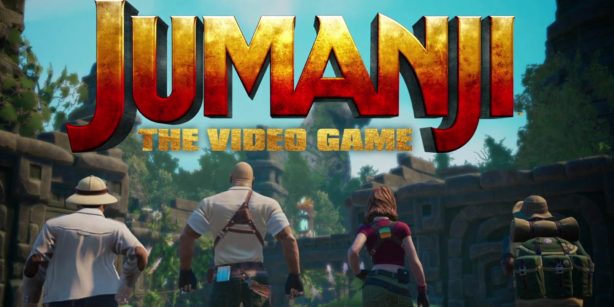
Publisher Outright Games and developer Funsolve, in collaboration with Sony Pictures, today announced Jumanji: The Video Game, the officially licensed game set in the world of the massively successful Jumanji film franchise.

Jumanji: The Video Game puts you in control of Jumanji’s greatest heroes as they seek to find the precious Jewels of Jumanji, save the world and find a way home. What’s stopping them? Only a deadly array of exotic creatures, dangerous locations and an army of evil marauders.

Unite with up to three friends on this hilarious adventure in online or split-screen modes, as you tackle all new Jumanji environments and choose your hero from Dr. Smolder Bravestone, Ruby Roundhouse, Franklin “Mouse” Finbar or Professor Shelly Oberon and combine their unique abilities to keep one another alive.

This is a dream come true for our studio. Adapting the exotic, dangerous and hilarious world of Jumanji into a video game has pushed us to create something truly special. We’ve got some incredibly exciting features and reveals coming soon, but for now let’s just say the game is coming this November, and puts you in the shoes of iconic Jumanji heroes.

Funsolve Founder and Director, Richard Tawn

Jumanji: The Video Game will launch on the 15th of November for PS4, Xbox One, Nintendo Switch and PC.

Visit us at http://www.gamersoutpostllc.com/