Cyberpunk 2077 has become a controversial topic to discuss since its release on December 10 last year, with its ‘fall from grace’ hitting major news networks around the world. After hitting a record-breaking 1 million concurrent players on Steam, CD Projekt Red’s futuristic RPG is now struggling to maintain 225,000 users less than 4 weeks after the game was released.
A fall in player base is to be expected of course, with previous games such as The Witcher 3 seeing a similar drop in users – though this took three months to occur.
For PC players at least, these numbers dropping at such an alarming rate are an interesting gauge for the satisfaction level of the gamers who purchased Cyberpunk 2077, and the potential future of the game itself.
Well that was quicker than expected
It’s easy to understand why we’re seeing such a dramatic fall in players when you look at the game issues documented by players across both PC and consoles, with bugs and hardware limitations rendering the game unplayable for some and unsatisfactory for many. A massive drop-off in player numbers is typical in video game life cycles and isn’t news in itself, but the speed at which we’re seeing gamers abandoning the game should concern CD Projekt Red.
Cyberpunk player numbers over the four weeks since release. (Image credit: GitHyp)
With recent history providing examples of games like Marvel’s Avengers and Anthem struggling to retain a player base, it’s not hard to see why developers should be looking to providing optimized products with replayable content.
Whilst not directly comparable as Cyberpunk 2077 is a single-player open-world game, consistent player numbers are important for future longevity developments like DLC and expansions.
The developer is currently working on a host of patches and bug fixes, and has already promised refunds for unsatisfied PS4 and Xbox One players after having admitted to not paying enough time on the version for the previous generation of consoles. CD Projekt Red’s diminished reputation may be a factor in the decline in players, so fixing the game to a better standard is keep to win back the trust that had previously fueled the years-long hype surrounding Cyberpunk 2077 prior to its release.
We’re hoping to see the issues ironed out over the coming weeks so that CD Projekt Red can salvage the situation and deliver a game that can be enjoyed by players across both PC and consoles. For now, we will continue to try and ignore the NPC’s T-posing in clubs and V’s pants disappearing during a gun fight.
You might recall that we highlighted Bloomberg’s excellent oral history of the original Xbox earlier this week, and as part of the feature, Xbox exec Aaron Greenberg revealed the PS2 played a notable role in the console’s development.
Various team members admitted that they were “so naive about the complexity” of building a brand-new console, and with no companies doing tear-downs, they took it upon themselves to strip a PS2 to its bare bones.
“In the old days, there weren’t companies that did tear-downs, so we actually had to take a PS2, we took the entire thing apart, put it on a giant wood board. We did a whole competitive review, and we went through every component, every piece and priced it out and tried to figure out how many screws and how much did it cost.”
The CEO of the manufacturer Flextronics also admitted that the team was “very transparent about the fact that they didn’t know what they were doing,” and the first version of the Xbox ended up having a failure rate of about 20-25%.
To make things worse, 200,000 consoles had to be reworked because the DVD drive was scratching the discs, but fortunately it all worked out in the end, and the Xbox was finally released on November 15, 2001 in the US.
Here’s what Microsoft co-founder Bill Gates had to say about the original Xbox team:
“One of my favorite things about Microsoft—and something I still love to do today—was getting to explore big, new ideas that might seem impossible to other people. We built the whole company around that. The early Xbox days were a great example—with a group of people who knew that gaming would be huge, and they believed Microsoft had a role to play even though it would mean starting something completely new.”
How do you feel about the original Xbox? Were you a fan? Let us know down in the comments.
PlayStation players can now order a special PS2-themed PS5, though not via Sony, Walmart, Target, GameStop, Best Buy, Amazon, or any other major retailer, but courtesy of SUP3R5. Earlier this month, SUP3R5 announced its “retro-inspired” PS5 console and PS5 DualSense controller. At the time, neither product was available to purchase, but today that changed. That said, if you want to pick up either of these custom-made pieces of nostalgic hardware, you will need to be prepared to fork over some additional cash money.
The special PS5 DualSense controller runs at $99 USD, while the console, which comes with the controller, runs at $649 USD. The former is limited to just 500 units, while the console is even more limited at 304 units. In other words, stock is going to vanish very, very quickly. In fact, by the time you’re reading this, both pieces of custom-made hardware may very well be sold out.
That said, if you decide to purchase either of these products, you should keep in mind that neither come the way of Sony, who may very well shut down the operation before any products are shipped out. Further, “the retro-inspired conversion process” for the controller includes a complete disassembly of the controller, which will void its warranty. The console does not require this, and thus its warranty shouldn’t be voided, but for now, there’s no way to confirm this will be the case. For the console, all SUP3R5 is doing is temporarily removing the side panels from the console. Again, this shouldn’t void the warranty, but for now, there’s no guarantee it won’t
It’s also important to keep in mind this is a new operation with no history, and the return policy is very vague. Meanwhile, full payment is required at checkout, though the product won’t begin shipping until sometime this spring.
The anticipation was big for “Cyberpunk 2077.” At 2019’s Electronic Entertainment Expo, attendees waited in line for a peek at the game from CD Projekt Red. (Myung J. Chun / Los Angeles Times)
by Todd Martens, Los Angeles Times
“Cyberpunk 2077” was always going to be hotly anticipated and highly debated. But now it’s a cautionary tale.
Since Keanu Reeves appeared last year at the Electronic Entertainment Expo to announce his participation in the title, excitement for the game has been at a level that greets a new Marvel film. And the fact that it would deal with topical subject matter — including arguably questionable looks at gender, race and politics — meant that fans and the media alike were eager to spend time with the game.
But the game is broken.
Sony on Thursday even took the drastic step of removing the game for the foreseeable future from its online store on PlayStation consoles. For those who have already bought the game, Sony is granting refunds. On Friday, Microsoft responded by offering fans a refund but is keeping the game available for sale on its Xbox consoles. The game’s developer, the fan-beloved CD Projekt Red, whose “The Witcher 3” remains one of the most celebrated games of the just-completed console generation, has pledged to fix the game.
Updates that would place the game in a desirable state are weeks and potentially months away. The Warsaw, Poland-based CD Projekt Red stated that by February the game should have enough patches to run adequately on the PlayStation 4 and Xbox One. The game is not without issues on the new PlayStation 5 and Xbox Series X either (it has crashed on occasion for me on the former), but it works much better on the new hardware. Still, the new consoles, released just last month, are in short supply. For those playing on older consoles — the majority of gamers — “Cyberpunk 2077” exists in a too-fragile state.
Sony in its statement Thursday said the company “strives to ensure a high level of customer satisfaction, therefore we will begin to offer a full refund for all gamers who have purchased ‘Cyberpunk 2077’ via PlayStation Store.” On Friday, Microsoft wrote, “To ensure that every player can get the experience they expect on Xbox, we will be expanding our existing refund policy to offer full refunds to anyone who purchased ‘Cyberpunk 2077’ digitally from the Microsoft Store.”
Forced to crunch
For much of the last week CD Projekt Red has been on an apology tour, even amid touting that the game received more than 8 million preorders. Media advances were given only on PCs, where those with high-end computers have experienced minimal issues. But the game looks and feels considerably different on the PlayStation 4 and Xbox One, leading to questions about how the studio previewed the game, and if the project it touted was different from the one it would sell.
“We would like to start by apologizing to you for not showing the game on base last-gen consoles before it premiered and, in consequence, not allowing you to make a more informed decision about your purchase,” read a statement attributed to company’s executive team. “We should have paid more attention to making it play better on PlayStation 4 or Xbox One.”
Work-from-home constraints of the current COVID-19 pandemic are certainly presenting challenges across many industries, and “Cyberpunk 2077” was subject to numerous delays during the last year. To make its ultimate Dec. 10 release date, the company admitted that some staffers would be forced to crunch, that is work something akin to an around-the-clock schedule to finish the game.
Though the game is in a playable state for those with the most powerful, most expensive PC technology, the decision to push through with a wide release of “Cyberpunk 2077” simply heightens numerous questionable and unfortunate game industry tactics that have become the norm.
Chief among them: That it is OK to release a game in a near-finished state, knowing that in the coming months it would be a drastically different product.
Though it’s admirable that the game medium allows for constant updates, turning games into a livable work, this also takes fans for granted, believing they’ll still be there when the work is done. To oversimplify it, imagine a film released in an incomplete state, with the studio and the creative team simply expecting consumers to rewatch it in six months when it’s actually finished.
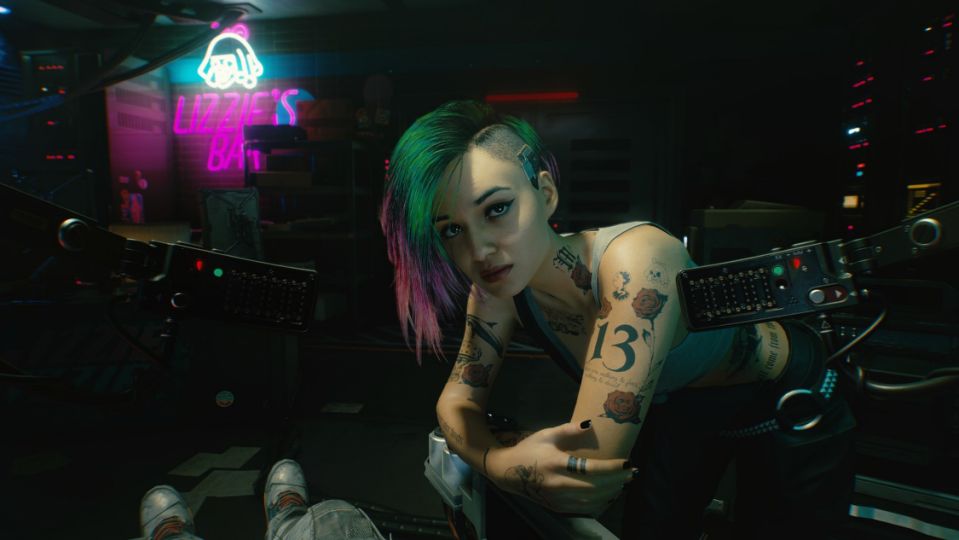
A screenshot from ‘Cyberpunk 2077.” (CD Projekt Red)
‘Early access’
Some developers embrace these challenges.
Games are a complex medium that stitches together art, technology and narrative components, all of them shifting based on the needs of the other elements and advancements in everything from computer power to game engine updates, not to mention user feedback.
There is the practice of releasing a game in so-called “early access,” providing a more transparent look at the development process. This year’s critically adored hack-and-slash game “Hades,” for instance, was available to purchase in a pre-release form for two years before it was properly finalized.
This can, however, deal a blow to any sort of publicity and marketing campaigns. The game industry is highly secretive, and often attempts to turn meaningless details such as the reveal of a character’s name into a news story. Early access destroys this careful build-up.
Additionally, when “Hades” came to the Nintendo Switch it may not have been seen as a brand “new” game. But also, by this point any underlying issues were worked out, and once people started playing the game word of mouth spread that “Hades” excitedly merged story and gameplay.
I personally avoid games released in early access. While it can be interesting to see how a game evolves, it simply makes more sense for me to wait until the game is at the state its developers want it. It’s safe to say “Cyberpunk 2077” isn’t there. Thus, at this point, it would be recommended for console owners to not play “Cyberpunk 2077” until its issues are smoothed out. The game that exists now will not be the same game that exists in a few months.
But the decision to rush “Cyberpunk 2077” before the holidays also points to long-standing and underlying issues about how the mainstream industry views its entertainment. CD Projekt Red was aware of the game’s hiccups, even admitting that it failed to show how the title ran on the PlayStation 4 and Xbox One. For all the supposed big ideas about the future of our world that the game possesses, this is evidence the studio ultimately considered it little more than a product, one that was so hotly anticipated that consumers would overlook the fact that it was not ready for prime time.
While The Times was offered interviews with the CD Projekt Red team for a story that could run around the launch of the game, I’ve increasingly grown skeptical of doing game features before having the ability to play the game in my home. Game events or previews are often carefully tailored to show a fraction of the title that runs mostly fine in a stitched-together state, with public relations reps interrupting interviews anytime the conversation strays from the specific moment of the game that the company has deemed as safe to cover — often detailed in nondisclosure agreements that The Times isn’t allowed to sign.
Instead, not having access to a PC that could run the game, we confined our coverage to an interview with Reeves. The actor was certainly interested in the power of the interactive medium, and spoke with curiosity on how user choice allowed him to essentially play multiple versions of the same character.
Reeves himself hadn’t seen the finished version of the game at the time we talked — and he acknowledged he would need a more game-inclined friend to show it to him. His interest in the game seemed fueled in part by the success CD Projekt Red had with “The Witcher 3” and in part to gain a better understanding of how games would impact all media.
“I don’t know where it’s going, but I know it’s going to be wacky,” he said. “It’s a good kind of puppeteering. Like, if I can play with the animation, I have more control.”
And yet it’s rare, as we just saw at the Game Awards this month, for a developer to be allowed to speak candidly about the art, the theories and the politics that inform every game. In such a climate, video games are handled with the cold precision of a new tech product rather than a work of entertainment. Thus, critical analysis around games is more vital than ever.
In turn, the legacy of “Cyberpunk 2077,” regardless of how it rebounds in 2021, will be that it is remembered as the work of a studio that disregarded the time its development team needed to finish the game — and in turn viewed its fans and the media with cynicism, even as it courted both with a product it specifically hyped as being politically edgy. It’s far from the first time this has happened, but rarely has it been done with such callousness.
Losing the rights to the thing you made is a surprisingly common situation in the games industry.
Obsidian Entertainment is one recent example—last year the studio released sci-fi RPG The Outer Worlds after years of constant praise for Fallout: New Vegas, which it couldn’t continue. Elsewhere, Atari held the rights to Rollercoaster Tycoon, so Frontier corkscrewed right around them and made Planet Coaster. Two or three of these spiritual reboots pop up each year: Two Point Hospital, Phoenix Point, Yooka-Laylee. Further back, BioShock.
Left 4 Dead creators Turtle Rock Studios found themselves in this same license limbo over the last decade, having carried a genre-defining co-op zombie shooter to term in 2008 before passing their baby to Valve, who’s mostly slept on the franchise (there was a surprise community update in September).
In Back 4 Blood, you feel Turtle Rock’s pent-up passion for zombie co-op. The shooter unapologetically walks in the footsteps of what we played in ’08 and ’09. It’s is a more visually polished game, of course, but its basic parts are identical: four-player, run-and-gun shooting through criss-crossing urban and outdoor post-apocalyptica (in the first 15 minutes: apartment, rooftop, construction site, haphazard parking lot), conventional military weapons, and a procedurally-driven “Director” AI overseeing the action, pulling the strings. More Kubrick than Spielberg, this Director.
Atop that foundation, even finer Left 4 Dead details have been transfused into Back 4 Blood. When you heal yourself with a medkit, the camera pops out into third-person until the bandage-wrap animation completes. You can grab a defibrillator to revive downed teammates quickly and, if they die outright, they can be freed later on in the level to rejoin the team. The special infected include a wobbling vomit-launcher, a wall-crawling “Hocker” that can root you in place, and the Bruiser, whose swollen right arm creates almost the same silhouette as L4D2’s Charger. Saferooms are scrawled with fearful and funny graffiti. Even some of the same weapons are back for blood: Molotov, fire axe, machete, AK, M4, Uzi, a set of throwable firecrackers that draw common infected away from you.
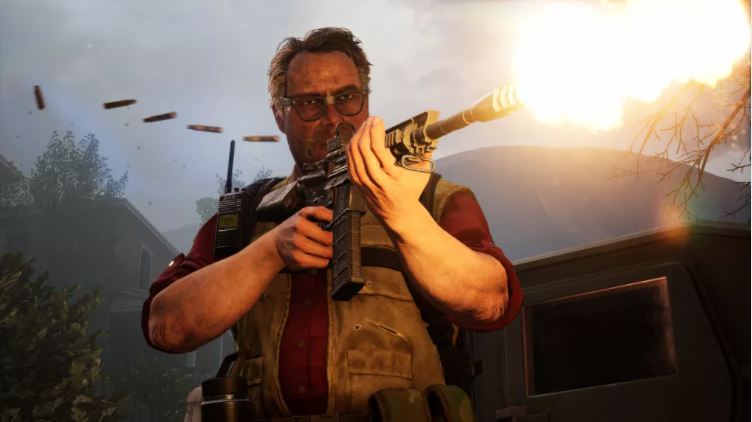
Image credit: Turtle Rock Studios
It’s a long list of resemblances. After playing the imminent alpha for a few hours, one question I’m left with is how many new ideas Back 4 Blood will need to be a great, fresh experience. Will Left 4 Dead actually hold up well as a style of game in 2021? When I replayed that aforementioned community update in September, it surprised me how poorly some aspects of the shooter had aged. Sudden “crescendos” of action felt tedious. Guns lacked personality and nuance. My biggest gripe with Left 4 Dead in retrospect is that you’re shooting almost constantly from beginning to end, with only a saferoom finish line there to supply a moment of pacing. It can leave you with a rabid, frayed brain, something I felt in this early version of Back 4 Blood too.
It’s possible that Back 4 Blood could inherit some of Left 4 Dead’s lack of rhythm. The alpha did show a couple signs of this being an issue—on three occasions when I ran maybe 30 meters ahead of my teammates, I encountered absolutely zero infected, something that Left 4 Dead routinely punished. And in a big finale event on a massive, three-level cruise ship, my team had the opposite problem: infected streamed in non-stop, without a single break in the action. It was like swimming against the flow of a gushing zombie river.
But spawn behavior is the sort of thing that can be ironed out during development. Maybe the more critical question is what Back 4 Blood’s overall campaign structure will look like, and whether it’ll meaningfully differ from Left 4 Dead’s roughly symmetrical chapter-segments. Turtle Rock told me that Back 4 Blood will have a “bigger” story than Left 4 Dead, one not simply about fleeing the infected, but about taking back the world from them. You’re not a survivor, you’re a “Cleaner,” an immune fighter who’s seemingly working with a remnant military force.
We do know that Back 4 Blood won’t be an open-ended, globetrotting World War Z affair. The Cleaners are stationed in a stronghold called Fort Hope, the nucleus of the setting, and from there you’ll “take missions and go out into the city,” rescue people, and go out into the world, studio co-founder Chris Ashton told me. “There’s NPCs, there’s dialogue … You know at the outset of each mission what your objective is, and sometimes that objective goes all wrong … we’ve got intros and outros to missions, we’ve got radio communications, we’ve got our dynamic VO system.”
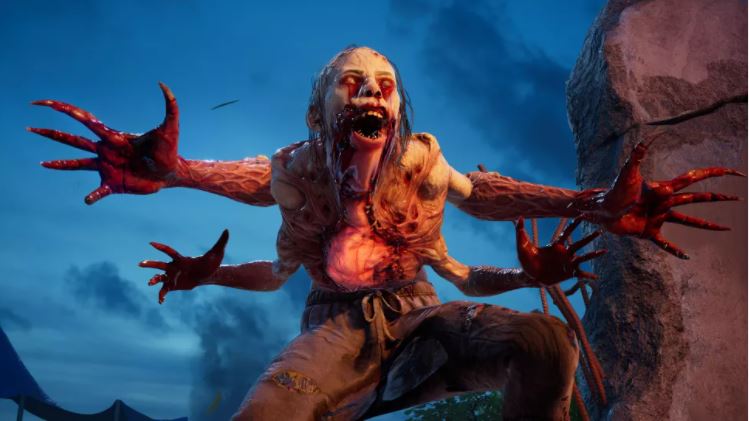
Image credit: Turtle Rock Studios
What I played was light on storytelling, but in the final chapter of the alpha a convoy of military vehicles roll up to a cruise ship terminal, guns blazing, asking us to run back into danger and blow up the cruise ship. I’m hoping there’s a lot more worldbuilding and storytelling moments to chew on like this—Left 4 Dead was plotless, relying almost entirely on light environmental cues to string together a theme. The best tool at Turtle Rock’s disposal will be the wider roster of eight characters, who the studio promises will each cast their own perspective on the environment, contributing some replay value through different voice lines.
Maybe the most novel mechanical trick Back 4 Blood has up its sleeve is a light card-based system, if you can believe it. It works almost like a soft pick-and-ban scheme that you’d find in Dota 2 or Rainbow Six Siege. Before each match the AI lays down a few cards (between two and four, in my sessions) that announce which enemies or conditions the next mission will include, like fog. In response, each player throws down a handful of their own modifying buffs, from straightforward boosts to ammo or health capacity to more interesting tweaks like healing on melee kills. When my teammates and I died, I liked that this system replaced some of the tedium of having to repeat a mission with strategizing—after each death, you can toss another card into play to improve your odds of success. These cards can be found hidden in levels or unlocked as a form of progression.
Two more smaller-but-significant changes shouldn’t go unnoticed: 1) you can sprint now; 2) guns have iron sights, partly to accommodate a new weapon attachments system. I still ended up playing Back 4 Blood mostly without ironsights—the missions I played didn’t exactly encourage us to stand still and aim. But the addition of modular weapon attachments you can find in the environment or purchase before each mission is welcome, partly because it’ll force more complex decisions than the rock-paper-scissors of Left 4 Dead’s rifle-shotgun-sniper weapon set.
How much Back 4 Blood does ultimately alter the experience it’s unapologetically resuscitating hinges on Turtle Rock’s promises of a bigger experience that plays out over the course of a campaign, almost all of which has yet to be revealed. We also don’t know if Back 4 Blood will be moddable, or how far down the “service game” path Turtle Rock and Warner Bros. will take it (will there be a season pass?), questions they weren’t ready to answer quite yet. You’ll be able to judge some of this for yourself very soon: the alpha just went live today, and runs through December 21st.
Cyberpunk 2077 has some scenes which can cause an epileptic seizure. Unfortunately, one reviewer found this out firsthand.
Game Informer’s Liana Ruppert has struggled with epilepsy after an injury she sustained during her time in the military, she explained in her recent Cyberpunk 2077 review.
In the piece, Ruppert said she suffered a grand mal seizure when playing through a braindance, which is a sequence in the game featuring rapidly flashing lights.
In response to Ruppert’s piece, CD Projekt said it will add a more prominent warning in the game for epileptic triggers and impliment more accessibility features in the future. Ruppert responded positively to the news.
“Thank you so much for listening!” she tweeted. “I’m so proud of how far accessibility has come and while there’s more work to do, it takes moves like this to make them happen. I look forward to learning more about the steps being taken so that everyone who wants to can enjoy Night City!”
Epilepsy is becoming increasingly common among Americans and at least 3.4 million Americans live with it today, according to the Center for Disease Control and Prevention.
For a game of Cyberpunk 2077’s stature, not even including a warning prompt at the beginning of the title feels like a big oversight. It’s also not difficult to implement.
In 2009, Call of Duty: Modern Warfare 2 made headlines for its infamous “No Russian” mission. It featured a squad of Russian terrorists gunning down civilians in an airport in order to spark a war with the United States. The player is a C.I.A mole in the squad who can choose to participate or not.
Because of its violent and disturbing nature, players were given the choice to skip the mission entirely.
CD Projekt adding a separate warning in the game to inform players with epilepsy is a welcome move. There’s no word yet on whether the permanent solution they discussed would be skipping the braindance sequences entirely or to have them reworked so anyone can enjoy them without fear of seizures.
Thanks to Ruppert, millions of gamers will now have a heads up about triggers that could await them in Cyberpunk 2077.
Cyberpunk 2077 has only been available for a couple of days, but its first post-launch patch is already rolling out. Hotfix 1.04 is already available to PC and PlayStation players, and CD Projekt Red says it should go out “as soon as possible” on Xbox platforms.
There’s a long list of tweaks for various mission-based issues that could otherwise interrupt your gameplay, and there’s nothing specifically mentioned about the rogue penis problem, but the most important adjustment is probably to the game’s “bytedance” segments. As highlighted by Game Informer reviewer Liana Ruppert, it included a sequence of flashing lights that could trigger epileptic seizures. CDPR said it would address that, and in the notes says that now “The effect has been smoothed out and the flashes reduced in frequency and magnitude.”
There are, of course, unspecified changes to resolve problems with crashes and improve stability, and specific tweaks on PS4 and Xbox One to improve the quality of reflections.
Some players on Reddit have had issues launching the game after installing the patch, but it’s unclear whether that’s due to problems with the patch or waiting for it to finish unpacking. For PC players the update is a little over 1GB, but on PS4 people have noted a 17GB download.
A new patent which was filed by Sony this year and found by T3 could suggest that Sony is looking at releasing an even more powerful PS5 Pro model with a dual-GPU inside.
The patent’s abstract reads as follows:
“In a multi-GPU simulation environment, frame buffer management may be implemented by multiple GPUs rendering respective frames of video, or by rendering respective portions of each frame of video. One of the GPUs controls HDMI frame output by virtue of receiving frame information from the other GPU(s) and reading out complete frames through a physically connected HDMI output port. Or, the outputs of the GPUs can be multiplexed together.”
And when delving deeper, you can find that the patent says that this would be a “scalable game console” where “a second GPU communicatively coupled to the first GPU”. The system would then be used for “home console and cloud gaming usage”.
This patent is interesting and could suggest that we might see an extremely high-end PS5 unit at some point in the future, with the two graphics cards likely increasing the price of the console dramatically. The patent also describes how this system could contain more memory and other features.
A PS5 Pro would be stunning to see, especially as the multiple GPUs might create one of the most expensive consoles in a while and further cement the idea that consoles are just becoming PCs. What are your thoughts on the possibility of a PS5 Pro?
Square Enix has yet to earn back the money it spent on the development of Marvel’s Avengers. In its most recent earnings report, spotted by IGN, the company said its HD Games segment posted a 7 billion yen (approximately $67 million) loss for the quarter.
Yosuke Matsuda, the president of Square Enix, attributed the downturn to a combination of poor sales and an expensive advertising campaign the company ran to promote the release of the game. “The HD Games sub-segment posted an operating loss as initial sales of Marvel’s Avengers were lower than we had expected and unable to completely offset the amortization of the game’s development costs,” he said. The executive went on to say Square Enix hopes DLC like the Kate Bishop add-on developer Crystal Dynamics announced last week will make the game profitable over the long run.
To find out Marvel’s Avengers has been struggling isn’t too surprising. When we previewed the game ahead of its release, we didn’t come away with a strong positive impression of what it had to offer. It also highlights that live-service games are a risky proposition for publishers. Much-hyped titles like Anthem have fizzled out, and even a heavyweight like Destiny has struggled at times, leading to a split between the game’s developer and publisher. Even with a lucrative property like The Avengers, there’s no guarantee a game will find an audience that can sustain years of ongoing development.
November 2020 feels like a lot of things, but the start of a new console generation isn’t one of them. And yet it must be, since I’ve been staring at the enormous, unmistakable body of Sony’s PlayStation 5 for over a week now, playing games new and old to see what “Next Gen” means for the future of interactive home entertainment.
This is a great time to release a game. The ongoing coronavirus pandemic has resulted in huge swaths of the world’s population spending far more time at home than they’d like, and with the rapidly rising infection rates, particularly in the U.S. and Europe, that’s not changing anytime soon. People are starved for content. Netflix has gotten less interesting and more expensive, while the launch of all the new streaming services over the last 12 months—including the already-failed Quibi—has further fractured and confused the content-consumption experience.
The video game industry has provided when it could; titles like Final Fantasy VII Remake and The Last of Us Part II drove gaming discourse for weeks and months, while Animal Crossing and Among Us grew big enough that both were used in the final weeks of the U.S. election cycle to get out the vote—the former with Joe Biden’s campaign island that players could visit, and the latter with Rep. Alexandria Ocasio-Cortez’s breakout Twitch stream that became one of the biggest in the platform’s history.
Even for those tightening their belts in an economically fraught time, the occasional video game to help relieve some stress seems like an appropriate purchase. But a new console? Especially one that is going to have a $70 base price for its games (ending the $60 standard set with the Xbox 360 in 2005)? Read the room.
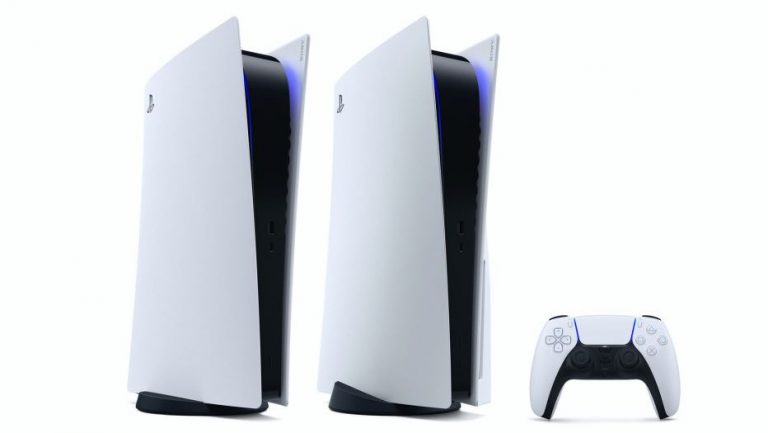
At least the prices aren’t as bad as the rumor mill suggested. At launch, the PlayStation 5 is $400 for the “Digital Edition” and $500 for the “Standard” model. Where Microsoft has created two similar-but-different boxes in their $300 Series S and $500 Series X consoles, Sony’s two systems are internally identical with a single difference: a disc drive. The Standard PS5 has a UHD Blu-ray drive from which it can play movies and physical games, while the Digital Edition requires everything exist entirely on either its super-speedy internal storage or a compatible external drive.
This is both a massive shift and none at all. There was talk leading up to the unveiling of the PlayStation 4 and Xbox One that the companies might release versions of their systems without disc drives. Back then, it was largely centered around an industry-wide backlash against the idea of used games, but now it’s a reflection of consumer behavior. In yet another trend accelerated by the pandemic, 2020 marked the first time more games were purchased digitally than physically—and it’s hard to imagine going back if and when this is all over.
Looking at the console, I imagine that Sony prefers the Digital Edition. Not just because they’re financially incentivized to have you buy a system that requires any purchases be made through their store, giving them the cut of every purchase that Amazon, GameStop, et al. take on physical media, but because that version simply looks nicer. When put side by side, the extra disc hump looks almost tacked on, and it makes an already garish design downright ugly. Regardless of version, the PS5’s curvy, white-with-black design is an active repudiation of the sleek all-black box Sony has been pushing since the PlayStation 2. It is also unapologetic in its hugeness. This is the largest video game console in decades and will be a struggle for some to fit under their TVs. It barely fits beneath mine, and I am a little worried about the cramped space impacting airflow and causing the system to overheat. (So far, so good.)
But while I may not like the way it looks in my entertainment center—and I really don’t—what matters is when the magic happens, when I get that controller into my hands and turn the thing on. Sony has made some unique choices with its new “DualSense” controller that do sometimes feel a little like magic. The general language of game controllers has become pretty standardized over the past few generations, and they’re all pretty good. I’ve always preferred the asymmetrical analog stick placement used by Microsoft and Nintendo to Sony’s, but all modern controllers feel good, and this is no different.
The color scheme matches the console: mostly white, with black accents. The button layout and placement echoes its predecessor, the DualShock 4, with speaker, lighting, and clickable touch bar included, but there’s one addition: a dedicated microphone on/off button to accompany the new mic built into the controller. I can see it being a nice addition for those who want to play online but don’t want a full-on headset, but it’s also a gimmick used for the gimmickiest part of the PS5’s pack-in game, Astro’s Playroom. Astro’s Playroom is a 3D platformer that is, at its core, a way to show off the new controller wrapped up in a whole lot of PlayStation fan service. It’s a fun little thing that has some neat ideas and also an onscreen prompt telling me to blow into the microphone to make wind. I thought we were over that after Nintendo did it in 2015, yet here we are.
Far more intriguing are the changes you can’t see: a pair of technologies that completely change the way games feel. First is haptic feedback, which is basically super-fancy rumble. Where traditional rumble just, well, rumbles a whole section of the controller, haptic feedback is targeted. So, for example, when someone is typing on a keyboard in the PS5 version of Spider-Man: Miles Morales, you will feel small little taps, as though you were pressing a key down and it was pressing back. This is primarily a way to make your connection to the digital world a little more tactile, but the precision of it could allow you to feel the individual ticks during a lock-picking mini-game. It’s just a nice little extra bit of immersion… though it doesn’t alter the actual experience of playing the way so-called “adaptive triggers” do.
While I had read that the “trigger” buttons on the DualSense—the back-most buttons on each shoulder—could change their resistance, I didn’t really understand what that meant until I felt it happen. It’s bizarre. Astro’s Playroom is actually a perfect showcase for it: I was just doing my regular running and jumping when all of a sudden I got zipped up into a suit attached to a giant spring. And now I need to spring my way through the next section. A prompt tells me to pull the trigger, so I do…but it didn’t move. It was suddenly fighting back. I pushed harder, and down it went and so did Astro. Seemingly by magic, the controller had changed its physical properties: it truly felt like I was pushing down on a spring to wind up, so much so that I got tired and had to switch to my middle fingers in order to complete the section.
The combination of haptic feedback and adaptive triggers resulted in a genuinely new experience, and it didn’t stop there. Another area had me pulling a lever to get something from a toy-capsule vending machine. The start of the pull requires the increased pressure, but once it hits the point where the in-game mechanical slot has finished, the real-world resistance gives way, and the last little bit of movement happens easily. It’s an extremely visceral feeling, and I can only imagine how this technology is going to be used in games down the line.
Which, unfortunately, brings us to the big caveat in all this: The reason I have to imagine how the technology might be used is because there aren’t many games to actually show me. This is one of the thinnest launch lineups in recent memory, with the only one thinner perhaps being the Xbox Series X/S’s after Halo Infinite was delayed to next year. That’s not to say there aren’t some solid games available for prospective buyers: there are (more on that next week!), but many of these day-one titles are going to be available on the PlayStation 4 as well, including that Miles Morales Spider-Man spin-off. Any cross-generation games will look and play better on PS5, but the only big exclusive at the launch of a new system is a remake. The new Demon’s Souls does look very good. Is that worth $400+?
There’s no question that the PlayStation 5 is a very powerful machine with a lot of technology under the oversized hood that will make games load faster, play better, and look amazing. Heck, it’s already doing those first two things to many existing PlayStation 4 titles. More than 99 percent of PS4 releases are playable on the new machine, and certain games have already received updates to specifically take advantage of the extra power, with more to come. Even those that don’t get a specific update, though, get a little boost: extensive load times are dramatically lessened thanks to the switch from a spinning hard disk to a blazing-fast solid state drive, and occasional visual hiccups are smoothed over. This is all great! However, it makes the PS5 at launch feel more like a PS4 Pro-Pro than a true PlayStation successor.
Maybe I shouldn’t have been surprised. Any brand-new piece of technology is sold less on what it offers in the moment than its potential. That’s rarely been truer than with the PlayStation 5. This has been a strange and scary year for every industry, and video games are no exception. I have no doubt Sony had a brilliant strategy to slowly drip-feed information and excite the masses—and to better fill out this launch day lineup. But when everyone was sent home as the realities of the coronavirus became apparent, that got thrown out the window. Sony hadn’t even announced the price of the system two months ago, and they’re clearly having trouble manufacturing systems considering their pre-order fiasco. This launch feels less like a celebration than an obligation: they promised it would be out this year, and so it must be. So it is.
Still, I am looking forward to what the future holds—or what Sony believed 2020 held. The hardware is there. Now we need everything else to catch up.







 Gamer's Outpost Press (Archived)