p-t

by Nick Robinson

Konami is trying really, really hard to make you forget that P.T. ever existed. That plan is backfiring.

In the wake of Silent Hills’ cancellation, Konami has done virtually everything in its power to scrub P.T.’s existence from the face of the planet. First, it quietly revealed plans to remove the game for download. After that, the company made good on its threat, but those who had grabbed it previously could still re-download it. Then, in a nearly unprecedented step, Konami had the game wiped entirely from Sony’s servers, even for players who had downloaded it previously.

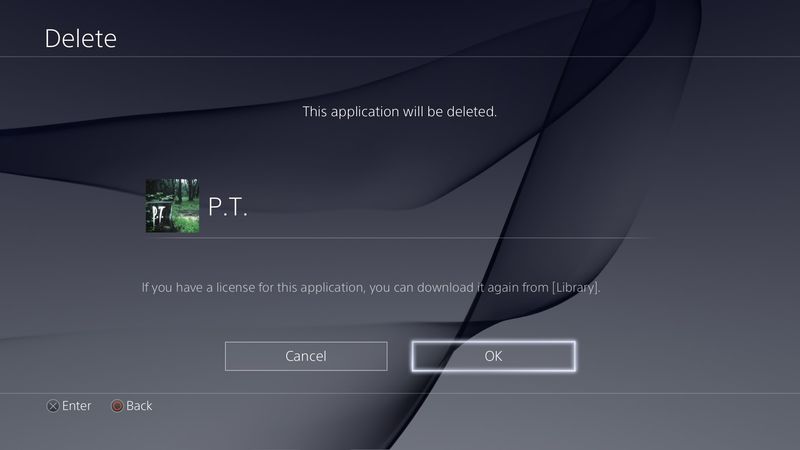
P.T.’s total eradication from PSN is such an unusual move that it actually renders the PS4’s game deletion screen incorrect or, at least, misleading: yes, it says you can re-download the game from your library in the future, but only “if you have a license” for it — and in the case of P.T., Konami just simultaneously revoked that license for every single person on Earth.

pt-delete_0

The consequence of Konami’s decision is this: There are now a finite number of copies of P.T. in the world. Starting this week, P.T. will never be downloaded by another human being ever again — the number of copies of P.T. will, from this point on, only ever decrease (barring interference from hackers and game archivists). Konami, in an almost impressive display of corporate anti-art, has found a way to attempt the first-ever murder of a digital game — and not just any game, its own game. This is likely one of the only times we’ll ever see this happen.

Of course, P.T. isn’t actually going anywhere; the game was downloaded over one million times, which means it’s backed up across over one million hard drives and SSDs in over one million PlayStation 4s all over the world. In reality, the game is not going to truly disappear — at least not until those hard drives start failing. But even then, Konami’s attempts to restrict access to P.T. are foolish, because copies will be made and encryption barriers will be broken. The coolest part, though, isn’t just that Konami failed — it’s how spectacularly the company’s plan has backfired.

The weird irony is that, had P.T. simply remained available, the number of people who are interested in playing it likely would’ve stayed roughly same as the number of people who have it already. But that’s not what happened; instead, Konami introduced scarcity to the equation, and instantly made P.T. one of the coolest, most fascinating games in the history of our medium. As of this week, P.T. is essentially the first rare, collectible digital video game. That’s … kind of rad.

lisa_photo_upstairs_0

Let me be clear: I hate, deeply, how Konami has handled the cancellation of Silent Hills. I think Kotaku’s Patrick Klepek nailed it last night when he ran the headline “Konami Sucks” — a headline that, in two words, summarizes how everyone who cares about this ordeal is feeling right now. Every single step of the way, it feels like Konami has made the most irresponsible, cowardly decision possible. As of this week, Konami has proven itself a company willing to go out of its way to actively destroy a critically acclaimed piece of art the millisecond it no longer financially benefits from that art’s continued existence. But believe me when I say there’s a silver lining: P.T., a game that most of us — even those of us who loved it — were mostly done talking about, is now more than ever a piece of gaming history to be treasured.

There’s been speculation that this isn’t the ending Konami wanted for P.T., that Norman Reedus’ face vanishing from the Silent Hills website was an indication that its contract with him had ended, and the decision to yank P.T. was out of the company’s hands. Even if that’s true, it feels like there are a billion other, far less nuclear ways Konami could’ve solved it: why not remove the sole cutscene that contains Reedus’ image (an ending that less than 0.1% of players likely ever saw), or work with Reedus, who publicly mourned the game, to keep his image in? Nuking an influential piece of artwork from orbit hardly seems like the answer. It’s a move that makes them look apathetic to the needs of their audience at best, and hostile at worst.

It doesn’t hurt that even before its recent demise, P.T. was already one of the most mysterious, interesting games ever created. Everything about P.T., from the bizarre concept of a ‘Playable Teaser’, to the pseudonymous manner in which it was released under the ‘7780s Studio’ moniker, to the way the internet came together (and continues to come together!) to solve its myriad riddles, would’ve been enough to make it historic on its own. Now, on top of all of that, it is rare. You couldn’t have come up with a better ending if you tried.

Rest assured, there are loads of people catching up on this week’s news who, before now, hadn’t heard of P.T., and suddenly they are dying to play this game. And they can’t — not easily, at least — and that’s sad, but at least they’re now aware of it. Even if they don’t know exactly what it is, they’ve heard of it, vaguely, and now it’ll remain in their memories forever; that mysterious, free PSN horror game that vanished in 2015. In a lot of ways, this is how urban legends get their start.

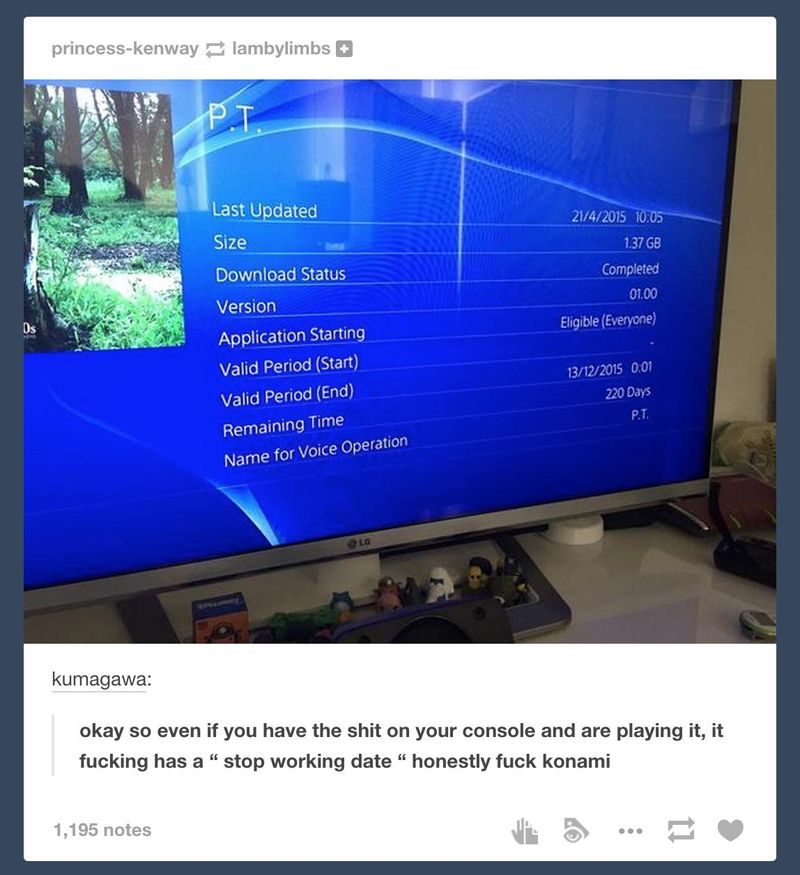
As a matter of fact, the P.T. apocrypha has already begun — just yesterday, a post with over 1,000 notes began circulating on Tumblr warning that this December, every single existing copy of P.T. would immediately stop working, never to be playable again.

2W5nZQ7__1__0

Ultimately, this rumor turned out to be false: it began with a tweet of the image seen above from Minecraft composer C418, who noticed the “REMAINING TIME: 220 DAYS” timer listed on his copy of the game. He later retracted his tweet, explaining that P.T. was a PlayStation Plus exclusive in Germany, so the date listed on that screen was just his personal PS Plus renewal date. By then, though, the damage had been done: a cursory Twitter search for “PT December” shows countless people who are now convinced that the game will be disappearing from their PS4s come this holiday season.

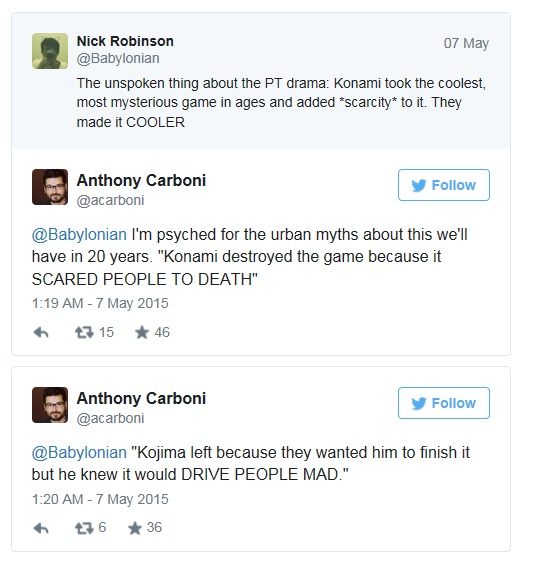
This, I’m convinced, is just the beginning of what I hope will become a vibrant tradition of P.T. misinformation spreading through the internet. My friend Anthony Carboni put it best:

Untitled

See, what makes spooky gaming myths so chilling is that they’re all unverifiable: Polybius is scary because, according to the myth, it only came to a handful of arcades; the Jvk1166z.esp creepypasta is scary because it’s a Morrowind mod that never actually existed. This lack of availability allows us to suspend our disbelief and more easily buy into the fiction. Konami has inadvertently granted P.T. some of that same scarcity, and in so doing has made one of the scariest games in years even creepier.

And look, even if it doesn’t become our generation’s Polybius the way I hope it does, P.T.’s 2014 birth and 2015 death are already two of the most significant events in gaming this century. In trying to demolish P.T., Konami has actually done the opposite: it has secured P.T.’s legacy as a monumental, scarce, cool-as-hell part of gaming history.

AC_Tease

by Giuseppe Nelva

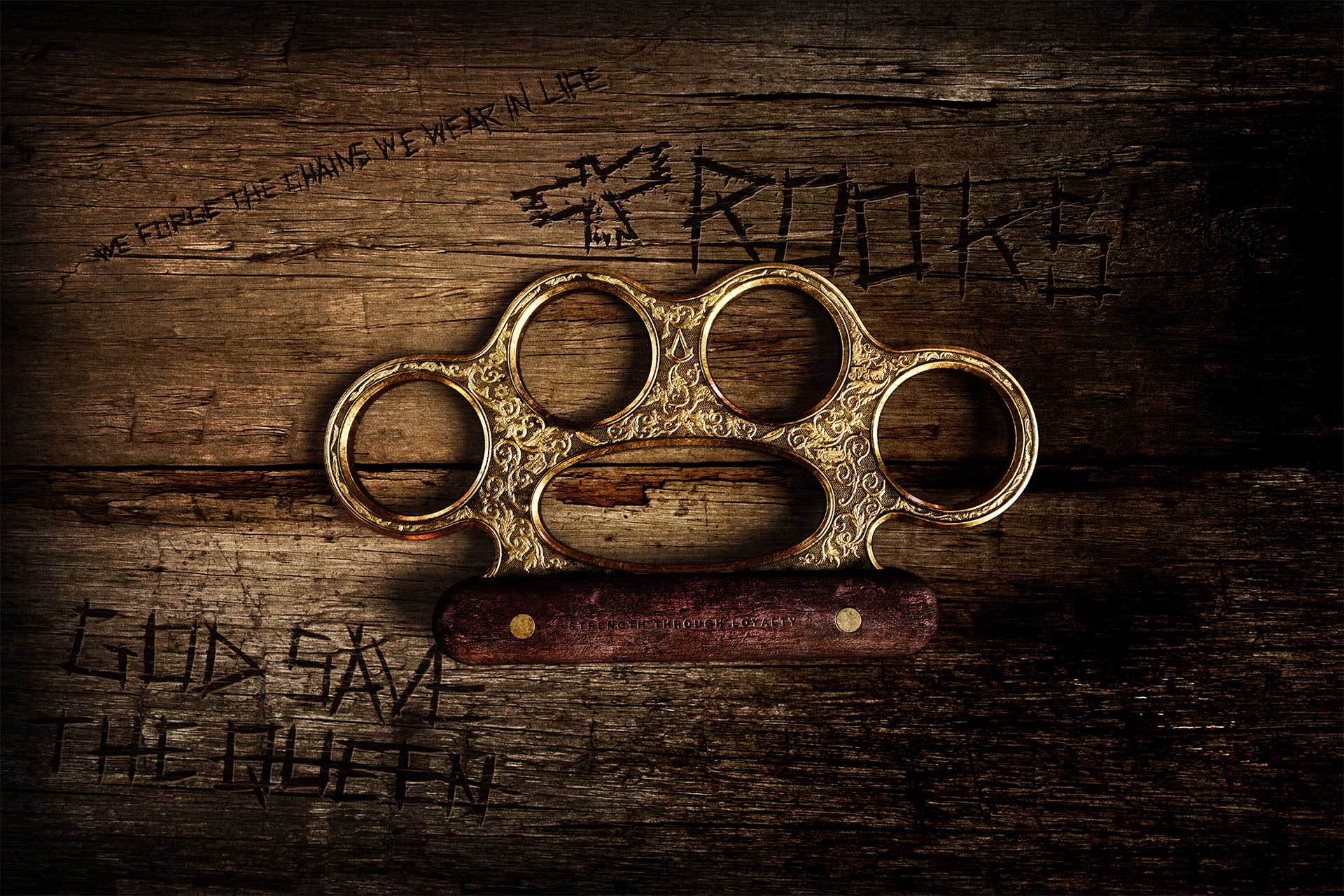
On Thursday Ubisoft teased the reveal of a new Assassin’s Creed game, and a new teaser picture that can be grabbed from the background code of the North American Assassin’s Creed website includes some interesting details:

First of all, a set of brass knuckles, that could be one of the weapons included in the game. Carved on the handle we can see the motto “strength through loyalty,” which is a translation of the popular latin phrase “fortius quo fidelius.”

The picture basically conforms the rumored British setting, as we can see from the “God save the Queen” motto. In addition to that, we also see the mention of “rooks,” which are crow-like birds prominently found in Great Britain, Ireland and Northern Europe.

Finally, we read “We forge the chains we wear in life,” which is a quote from “The Cricket On The Hearth” by Charles Dickens. The reference to the book also points to a Victorian setting, as it was published in 1845, eighteen years into the reign of Queen Victoria.

What this all means will probably be revealed on May 12th, but I can’t say my curiosity isn’t piqued.

PS360vsPS4Xbox1

by Alexa Ray Corriea

We’re in the eighth generation of home video game consoles, and of the three most popular options, two are not backward compatible. Nintendo’s Wii U offers access to its back catalog of Wii games through a separate console mode and to games from the company’s early days through the Virtual Console. But for the PlayStation 4 and Xbox One, owners have to count on remastered editions of their favorite older games or services like PlayStation Now if they want access to them on the newer machines.

It hasn’t always been this way, though. Previous console generations had the guts (literally) to run games from older hardware, but over time the cost of adding the extra technology to newer machines proved to be too high. Are we justified in feeling cheated out of consoles with backward compatibility? Or is it all just part of the industry’s evolution towards better, brighter experiences?

The history of backward compatibility

When we say something is backward compatible, it means that the object in question can work with input generated by an older product or piece of technology. If the new, most recent technology can receive, read, view or play input–like media–in older formats, then the product is backward compatible. In the case of consoles, when we talk about backward compatibility, we’re asking if the console can play games created for previous hardware in that console’s family. For example, early PlayStation 3 models could play PlayStation 2 and PlayStation 1 games, while the first run of the Nintendo Wii was compatible with GameCube games, memory cards, and even controllers.

The early years of video game consoles saw backward compatibility as a more common feature. But for some companies, it was harder than others.

Atari: The Atari 7800, released in 1986, was backward compatible with the Atari 2600 but not the console that directly preceded it, the 5200. This was because the 7800 included many of the same chips built into the original 2600. Users could put the 7800 into a “2600” mode that slowed down the console’s processor from 1.79 MHz to 1.19 MHz, which mirrored the 2600’s processor. In this mode, game data was accessed in 4K blocks rather than the 7800’s standard 48K blocks, allowing the newer Atari to read and play the older machine’s games.
Atari never released another true console with backward compatibility, but in 1987, the company launched the Atari XEGS, which could play the entire library of software developed for Atari’s 8-bit home computers. Additionally, the company developed but never released the Atari Jaguar II; the canceled project would have allowed users to play catridges for the original Atari Jaguar and Jaguar CD.

7014ff316f9b7c6787672a74cc5bbc3d

Sega: In 1983, Sega released the cartridge-based Sega Game 1000 in Japan; it would never be released outside of the territory. The company’s next machine, 1986’s Sega Master System, was built to be compatible with the SG-1000’s game cartridges. Following the Master System, Sega opted not to put the previous console’s chips in its next machine, the 1989 Sega Genesis, but instead made backward compatibility possible through a peripheral. Although the Genesis contained an 8-bit processor, this accessory, the Power Base Converter, had to be hooked up to the Genesis in order to play Master System games.

Sony: The PlayStation 2, which launched in 2000, allowed users to play PSOne discs, although PSOne memory cards were also required to access and store save data. PSOne controllers were also compatible with the hardware, although certain functions like the analog buttons were not available to use when playing PS2 games. Early PlayStation 3 models were backward compatible with both PSOne and PS2 games, and save files from PSOne and PS2 memory cards could be transferred to the PS3’s hard drive using a memory card adapter. When Sony debuted the PS3 Slim model in fall 2009, the company removed backward compatibility chips in order to make it a thinner piece of hardware. No PS3 models following the launch of the Slim have had backward capability.

Microsoft: The Xbox 360, 2005’s successor to the original Xbox, allowed for some backward compatibility but required several more complicated hoops to jump through. Unlike the PlayStation 2 and 3, players couldn’t put previous generation discs into the system and expect them to run. Playing Xbox titles on Xbox 360 required system software updates from Microsoft and emulation profiles. These emulation profiles were created for each individual game–there was no blanket solution for all Xbox titles–and could be downloaded straight to the console via Xbox Live or through Xbox.com and burned to a CD or DVD. Only Xbox 360s with the official Xbox 360 hard drive could run the emulation profiles.

In November 2007, Microsoft stopped creating emulation profiles for Xbox games. To date, there are 461 Xbox titles that are compatible with the Xbox 360. Any game without an official emulation will not work.
159ae78b071bca0c8b587d407a9de115

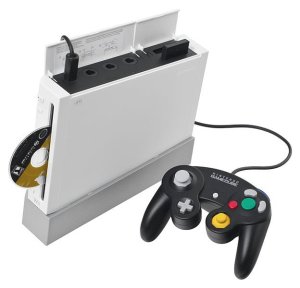
Nintendo: While Nintendo’s early consoles ran on their own media–with sizes and shapes of cartridges and discs varying between generations–it all came together with the Wii in 2006. Wii models made pre-2011 were fully backward compatible with Nintendo GameCube game discs, memory cards, and controllers. This was because the Wii hardware had ports for both GameCube memory cards, and peripherals and its slot-loading drive was able to accept and read the previous console’s discs. When playing a GameCube game, however, only GameCube functions were available, and only compatible memory cards and controllers could be used because the Wii’s internal memory would not save GameCube data. Online and LAN features of certain GameCube games were not available, however, due to the Wii not having serial ports for the GameCube’s Broadband and Modem Adapters.

The redesigned Wii Family Edition and Wii Mini, launched in 2011 and 2013 respectively, had this compatibility stripped out.

What’s the current situation?

Right now, Nintendo’s Wii U is the only console on the market with true backward compatibility. Wii software can be transferred to the Wii U and and accessed through Wii Mode by clicking on the “Wii Menu” home screen icon with a Wii remote. Speaking of which, Wii remotes and peripherals also work with the Wii U. In Wii Mode, games can be displayed on the GamePad screen, but Wii Remotes are still required to play them.

Additionally, Nintendo’s handheld lines also hold up in terms of backward compatibility. The Game Boy line read software from most previous incarnations of the handheld, with the exception of the Game Boy Micro. The company’s most current handheld, the Nintendo 3DS, can also play games from the Nintendo DS.

Neither of Sony’s current gaming hardware, the PS4 or PlayStation Vita, are backward compatible. The PS Vita cannot play the UMD discs of its predecessor, the PlayStation Portable, because there is no UMD reader; instead, the Vita utilizes small flash memory cards the size of SD memory cards. Compatible PSP games can, however, be downloaded from the PlayStation Network on PS Vita.

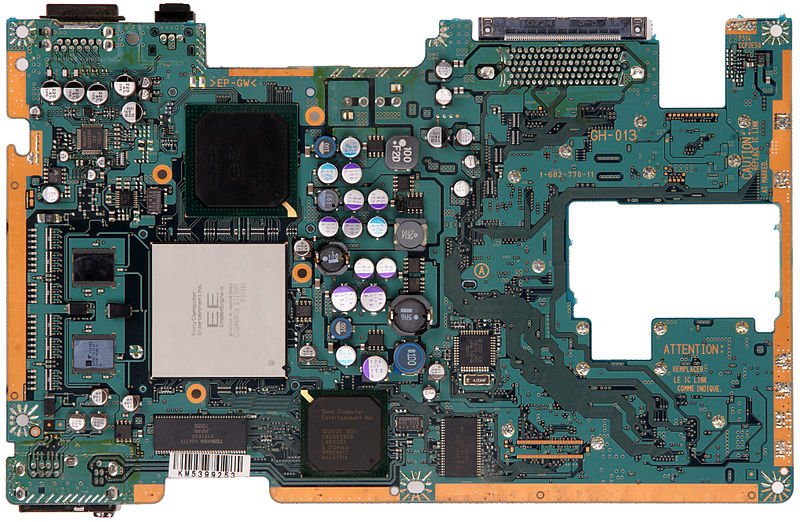
The main reason PlayStation 4 and Xbox One can’t play older games games is because both consoles use an entirely different kind of chip with a different instruction set. While older PlayStations and the Xbox 360 used PowerPC chips, the PS4 and Xbox One completely changed the guts of the system by using an x86-64 architecture, which is closer to Intel and AMD CPUs.

For PS4, Sony’s PlayStation Now service, currently in open beta, does allow users to stream PS3 games, but requires a subscription fee.

Speaking with GameSpot during the PS4’s launch in November 2013, PS4 architect Mark Cerny said that, while the plan for PS3 was to put PS2 hardware in every console, the move was impossible with PS4.

“Software emulation is very hard to do unless you have 10 times the frequency of the previous console,” Cerny said. “Software emulation is not about the overall performance that can be achieved by having a great number of processing units. It’s about being able to do things quickly. You’re trying to emulate your previous hardware, and that takes you a certain number of operations to emulate whatever it was doing. So, PlayStation 1 is emulatable on PlayStation 2 because there was an increase in the frequency of the CPU and GPU to something like a factor of 10. And the same thing is true between the PlayStation 2 and PlayStation 3. The PlayStation 2 is something like 300 Mhz; PlayStation 3 about 3.2 Ghz — about 10 times as much. But even so, it’s very, very hard to do.”

672516fc8b3632575b8e6677e5536eb9

“The world we’re in now, though, frequency has stopped increasing,” he added. “For example, if you look at your PC, the frequency of the CPU hasn’t changed much in the last ten years. And that makes emulation just really hard to do.”

Microsoft’s Xbox One is also not compatible with its predecessor’s media. Nor can you use the Xbox 360’s Kinect with the Xbox One; you must purchase the updated version of the peripheral. There is no PlayStation Now equivalent for Xbox One.

How do you make something backward compatible?

The more advanced the technology used for consoles becomes, the more difficult–and more expensive–it is to add the hardware or software necessary for backward compatibility. Consoles with more features will likely be pricier, and a current generation console with a the previous generation’s chipset would be wildly expensive; think of a PS4 or Xbox One with another $200 tacked on to account for the additional parts. This is one reason why Sony and Microsoft have shied away from including backward compatibility in their current consoles.

But just what does it take to make something backward compatible? There are two ways to go about implementing the feature: hardware implementation and software emulation. Either you have the exact hardware needed to run previous generation games, or you’re using the full power of the new hardware to emulate the previous generation’s software.

The best way to add backward compatibility to a console is to include the important pieces of the previous generation machine’s guts, like the CPU, GPU, and sound chips. For example, the Wii was able to play GameCube games because it was essentially a more powerful version of the GameCube. The PlayStation 2 also had the original PSOne chipset built in.

The other way, emulation, is a little trickier, and there are two different ways to make things work.

0bb2e373f4d4806ca45cf78f2c97350a

Dynamic recompilation ensures the most compatibility. This process takes code that has been written for one chip and, as the code goes through the CPU, translates it into code that the native hardware can interpret. This method may give hardware the best way to emulate software, but you need really strong hardware in order for dynamic recompiling to reproduce a 1:1 experience performance-wise.

Another way to emulate software is to add another layer of software that is written to mimic the hardware a code has been written for. This is the most common form of emulation because it doesn’t drastically affect a game’s performance. A good example of this is Microsoft’s approach to emulating Xbox games for the Xbox 360; individual emulation software was written for each compatible game. That’s the slight drawback: one emulation software can’t be created for multiple titles, so the code has to be created separately for each game needing compatibility. The downloadable PSOne games Sony has released for PS3 and Vita come with emulation code tailored to that specific game, which is why we haven’t seen every PSOne Classic released at once for any of the newer consoles. This is also how Nintendo is handling game releases for the Wii U Virtual Console.

For the Xbox 360, some games had additional compatibility updates to fix problems, but not all of them received these patches. Many Xbox games still have problems running on the 360, compatible or not.

The PS2 had a more powerful graphics system than its predecessor that could do parallel processing. When running a PSOne game on PS2, the timing between the hardware’s parallel processing and the running software had to be exactly right, or the game would break. Later, slimmer PS2s used software emulation for PSOne games, and as a result only supported certain titles.

What do Microsoft and Sony have to say now?

Last fall, Sony’s vice president of Sony Network Entertainment Eric Lempel stated in an interview with Game Informer that PlayStation Now could see the addition of PS4, PS2 and PSOne games in the future.

“In our plans going forward we’re looking at everything so there’s the real possibility that you’ll see PlayStation 1, PlayStation 2, and PlayStation 4 titles available,” he said. “Right now it’s just PlayStation 3, but these are all options for the future.”

Around the same time, head of Xbox Phil Spencer said Microsoft have heard fans’ cries for backward compatibility, and that something was in the works for Xbox One.

“Back compat is always a hot topic at the turn of a generation, and I get why, especially on [Xbox 360] so many people bought so much digital content and it means that a lot of us, we’re holding on to our 360s,” Spencer said. “I get the question. I totally respect the question. There’s nothing I can say about it right now, but I’ll just say ‘I hear you.’ I definitely hear you and I’ll continue to try to work to build something that can help people out.”

We reached out to Sony and Microsoft for comment on their plans to bring backward compatibility to current consoles. However, neither company could share any information at this time, other than reiterations of what we already know. A representation from Sony said the company’s long-term goals for PlayStation Now include bringing PS1 and PS2 games to service, but for now they are focused on PS3.

So this is where we are today: current consoles are not backward compatible, but with the recent rise in re-releases and remasters of previous generation games, we technically can play older games on newer consoles. The downside of this is the cost, as all of these remasters require an additional purpose. Moving forward, it seems that this is the likeliest way publishers will ensure we’ll be able to play their older games for years to come.

AndrewGarfieldSpiderman

by Roger Friedman

Thanks to the Sony hacks, via Wikileaks, we now know why Andrew Garfield won’t be making any more “Spider Man” movies– or maybe any Sony films for the foreseeable future.

It turns that Garfield insulted Sony chief Kaz Hirai by snubbing him last summer in Rio de Janeiro at a big Sony gala celebrating the end of the World Cup. Kaz had planned to introduce Garfield as the star of “Spider Man 3″ set for 2016 in a speech before 750 guests. But Garfield, having just arrived in Rio, made a huge mistake. He snubbed Kaz and never came down for dinner. Yikes. In Rio this didn’t go well, and the bad feeling reverberated. An email alerting everyone read: “Here we are about one hour away from our Gala event and Andrew decides he doesn’t want to attend. He has a rather scruffy beard and he just wants to be left alone.”

Kaz Hirai had planned on making this speech:

“Andrew is an actor who has graced the screen in roles in several important Sony Pictures Entertainment films, including The Social Network, in which he played Mark Zuckerberg’s onetime friend and co-founder of Facebook, Eduardo Saverin. The Social Network, to my mind, is the Citizen Kane of the 21st Century, a film that social historians hundreds of years from now will point to as one of the most emblematic of our era.

Another historic movie starring Andrew is The Amazing Spider-Man and The Amazing Spider-Man 2, which continues to weave movie magic in hearts and minds around the world. Together those two films have taken in more than $XXX million at the global box office.

I’m proud to say that Andrew will be returning as Peter Parker in The Amazing Spider-Man 3, which will be released in May, 2016.”

Needless to say, when Garfield didn’t come down for dinner, the speech was changed. Garfield next stars in “99 Homes” this September, and Martin Scorsese’s “Silence” with Adam Driver.

Here is a series of emails explaining all this:

Fwd: Andrew Garfield in RioBegin forwarded message:
From: “Clark, Nigel”Date: July 14, 2014 6:53:47 PM PDTTo: “Pascal, Amy”

Cc: “Blake, Jeff”

Subject: Andrew Garfield in Rio

Amy,
As requested, here are the relevant emails.
In red, at the very bottom: the email I received on Saturday afternoon, from Steve Bernard informing me that Andrew was not making the red carpet or the Sony gala dinner, and Kay Aoki’s response.

In blue: my email correspondence with Rupert upon receiving the news.
In black (immediately below): an email from Steve Bernard in response to my asking earlier today how Andrew was feeling.

As I mentioned when you called, it may very well be that Andrew met Kaz on the day of the match etc. I’m not aware of that.

Best,
Nigel

Very happy. Mark Wachter took him and Rupert surfing this morning. They are touring the city now.
Sony Music took them out for a late dinner last night.
I asked AG if he minded if I sat Santana next to him at the match. He had a big smile.

All good now

Stevan (Steve) Bernard
Executive Vice President – SEHS
Sony Pictures Entertainment

Rupert,
I’m sure the event was successful, despite Andrew’s absence. The last minute change to Kaz’s speech and to the seating arrangement was manageable, but it’s a slight to Kaz and the Sony hosts on the ground.
Nigel
_____

From: Rupert Fowler
To: Clark, Nigel; Enriquez, Vianne; Knight, Prue
Cc: Aoki, Keiko; Bernard, Stevan; van der Werff, Susan; Blake, Jeff
Sent: Sat Jul 12 16:13:35 2014
Subject: RE: URGENT URGENT: World Cup

​Hi Nigel,

He had been feeling under the weather all day and exhausted from coming off the plane early this morning so I gave as much notice as I could. Not ideal though I understand, hope it didn’t have too great an impact on things.
Rupert
_____

From: Clark, Nigel
Sent: 12 July 2014 19:56
To: Rupert Fowler; Enriquez, Vianne; Knight, Prue
Cc: Aoki, Keiko; Bernard, Stevan; van der Werff, Susan; Blake, Jeff
Subject: Re: URGENT URGENT: World Cup

Rupert,
I hear that Andrew decided at the last minute to skip the Sony event and dinner. Is that true? It puts us in an embarrassing situation with Kaz Hirai.
Nigel

That is extremely embarrassing….
But I will tell Kaz and change the seating and his speech!!
Thanks for letting me know.

Kay

From: Bernard, Stevan
Sent: Sunday, July 13, 2014 4:49 AM
To: Clark, Nigel
Cc: Aoki, Keiko
Subject: AG Problem – PLEASE READ
Importance: High

Nigel/Kay,
Here we are about one hour away from our Gala event and Andrew decides he doesn’t want to attend. He has a rather scruffy beard and he just wants to be left alone

twd_128.0.0

by Michael McWhertor

The console versions of Overkill’s The Walking Dead will be published by 505 Games, the same company that published the developer’s online co-op shooter Payday 2, the two companies announced today.

Overkill’s The Walking Dead is coming to PlayStation 4, Xbox One and Windows PC, 505 confirmed. The company also said that Overkill is working with The Walking Dead series creator Robert Kirkman to “create new characters, plots and story-arcs that will live in the ever expansive world of The Walking Dead graphic novel series.”

Kirkman said at SXSW last month that the new Walking Dead shooter will build upon Overkill’s experience with Payday.

“I can say that it will be Payday-esque because [Starbreeze and Overkill] are currently doing Payday,” Kirkman said. “But I’m told it will be in a bigger world than Payday currently encompasses. They are going to be learning a lot of stuff from Payday that they will be incorporating into The Walking Dead game.”

Overkill’s The Walking Dead was announced last summer as an online co-op first-person shooter, with an expected release coming sometime in 2016.

Microsoft_just_showed_us_that-2c82a9bca6608d4fa8b3de0ef9c8f2b8

by Matt Weinberger

We hear a lot about The New Microsoft, where cloud computing, mobile apps, and holographic computing are driving the company to record profits.

But at the same time, Microsoft’s traditional Windows and Office businesses are shrinking as the company moves to new software models where customers pay for monthly subscriptions, not boxed software.

At today’s Microsoft Build developer conference in San Francisco, it was abundantly clear that Microsoft is embracing and even driving this change. The company that’s basically synonymous with personal computing has moved past the personal computer.

It was two announcements that really show where Microsoft sees computing (and itself) going: The ability to use a Windows Phone running Windows 10 as a PC, and HoloLens, the holographic computer.

There was one particularly telling HoloLens demo on stage today. A Microsoft employee showed off a tiny, wheeled robot whose software was based on Windows 10.

When that employee put on her HoloLens, the robot came to life with a holographic avatar over its head. She was able to direct the robot around by pointing, and change its color by opening a virtual control panel over it.

It’s easy to extrapolate what this could mean. Any Windows 10 device in the real world could have a holographic bit associated with it. You don’t need a screen or a keyboard for a computer that’s the size of a credit card, if all of that interface is projected onto a table with something only you can see.

So why would anybody need a full computer at all?

A Windows 10 phone with an associated holographic interface could be all the machine you’ll ever need. Similarly, any other interface anywhere else could have the same deal. A totally nondescript desk could be an interactive collaboration space, if only it has an embedded Windows computer and you’re wearing your HoloLens.

This is all years off. Demand for personal computers may be shrinking, but they’ll still be around for a while.

But Microsoft is teasing a future where all you need to get through your day, at work and at home, is a phone and a hologram, and it wants its developers to help us get there as soon as possible.

If that means that the traditional PC market has to fall by the wayside, including its traditional software business, so be it.

7dbf8864a4b94fd4e68f815644743292

by Brian Crecente

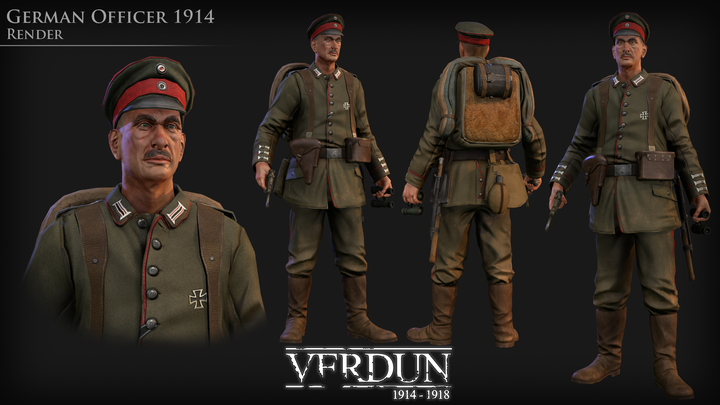
Multiplayer first-person shooter WWI game Verdun officially launched today on Steam, according to Dutch developers M2H Games and Blackmill Games.

The PC, Linux and Mac game was in Early Access on Steam for more than a year where it earned about 4,300 positive reviews out of nearly 5,000.

The game features authentic weapons and uniforms from WWI and includes maps from some of the battles that took place between 1914 and 1918 in France and Belgium, according to the developers.

Other features include “true trench warfare,” tactical squad combat and a variety of multiplayer modes.

Today’s full release of the game includes a bonus map called Aisne, based on an area in Northern France which saw some of the biggest battles during the early years of the war.

The developers promise that Verdun will get free thematic expansions over time, including the addition of Belgian and American troops for the Allies, and for the Central Powers some special German troops.

rachel-bryk-commits-suicide-600x330

by Ryan Martinez

Transgender game developer Rachel Bryk was told by cyber bullies to jump off a bridge, in the end that’s what she decided to do.

It’s a sad time for the gaming industry as it loses a creative young game developer to suicide. Rachel Bryk, 23, was a prominent transgender developer who was best known for her work on Gamecube and Wii emulators. Years before she dived into development work and joined all the communities involved in it, however, she had suffered from low self esteem and chronic pain. Those problems only grew worse after joining the only game development community where she was subject to constant harassment.

As many people know being gay or transgender in the gaming community can make you a major target for trolls and cyber bullies. Rachel Bryk was no exception, for months now cyber bullies told the young developer that she should jump from a bridge. On April 23, after months of this severe bullying Bryk jumped from the Washington Bridge in New York. Only weeks after posting on a 4chan VG that she would be leaving a number of online communities because of their treatment.

That post was also met with a wall of hateful message telling Bryk that she should commit suicide. Now as news of her death spreads scores of other game communities, like the one centered around the Dolphin emulator, mourn her loss. Memorials have appeared all across the internet to remember Bryk and the contributions she made to the emulators she loved.That outpouring of sadness at her loss has sparked a new discussion in the gaming world about homophobia and transphobia.

The strongest voices in that new conversation are the people she worked with on the Dolphin emulator. Rachel Bryk was an important name to anyone who closely follows Dolphin and her presence is already being sorely missed there:

“She was a very kind and helpful person, one of many to help guide me through the project when I first started to contribute to the program. Her contributions to both the TAS and Dolphin Emulator community were vast, adding multiple helpful and sorely needed tools to make Dolphin easier to TAS. Although I did not know her as long as the others, I know she will surely be missed by all of those who knew her.”

In memory of Rachel, here she is playing the hell out of her favorite game: Pucca’s Kisses Game.

Source: Dolphin Emulator Blog

“This was in no way intended to misrepresent the title on Xbox One.”

by Eddie Makuch

Earlier today, the official Microsoft Xbox YouTube channel published an impressive new video for CD Projekt Red’s upcoming role-playing game The Witcher 3: Wild Hunt. Since the video was published to the Xbox channel, some might have thought the gameplay was captured on the Xbox One edition of the game.

However, it’s now been discovered by Kotaku that the footage of the game shown in the video is from the PC edition, not the Xbox One version, despite the Xbox logo being featured prominently. Microsoft has since apologized for the confusion (more on that later).

2676231-the_witcher_3-wild_hunt_various_types_of_enemies_require_different_approach

Microsoft never explicitly stated that the footage was not captured on Xbox One, but–just a few hours after the video went up–the company added a disclaimer to the video to say the footage was “captured on a PC.”

One major giveaway that the footage was captured on PC and not Xbox One is that the gameplay video plays at 1080p/60fps. The Xbox One version of The Witcher 3, however, outputs at 900p/30fps, which raised some red flags–the video’s comments are overflowing with people pointing out the difference.

In a statement sent to GameSpot this afternoon, a Microsoft representative said it never intended to misrepresent the visual fidelity of the Xbox One version of The Witcher 3, and apologized for any confusion caused by the video.

“This morning we posted a new trailer for The Witcher 3: Wild Hunt to our YouTube channels featuring footage provided by CD Projekt Red that was captured from the PC version of the game and may not be reflective of final Xbox One gameplay,” the spokesperson said. “This was in no way intended to misrepresent the title on Xbox One. We have updated the description of the asset to make clear the source and platform of this footage. We apologize for any confusion and look forward to the game arriving on both Xbox One and PC on May 19, 2015.”

Whatever the case, The Witcher 3 looks quite nice across all platforms: PC, Xbox One, and PlayStation 4. But the PC version, like so many other games, is likely to look the best, as it will run at 60fps (if your computer can run it).

The Witcher 3 launches on May 19th.

5_1

by Chris Pereira

Bloodborne is not the sort of game that explains everything to you, and that’s part of its charm. But it’s only just now, weeks after its release, that players are beginning to realize that they’ve probably been making the game harder on themselves.

Early in the game, you’re given the opportunity to buy the Hand Lantern. This hangs off of your character and provides additional light, something that can be tremendously helpful in dark areas if you choose not to hold a torch in your left hand. There didn’t appear to be any downside to carrying one; unlike the torch, it doesn’t require you to sacrifice using a ranged or two-handed weapon. It’s simply something you buy once and should equip after every death.

As it turns out, there is a downside: It reduces stamina regeneration, making it take longer before you’re able to attack or roll away from enemy attacks.

This is the discovery of a number of Reddit users, including Lucky_Number_Sleven, TCSyd, and Xarius478. They’ve also found that this is true not just of the lantern, but any equipment–whatever you have equipped will weigh you down and cause your stamina to take longer to regenerate.

There’s still work to be done to work out all the details, but the video above demonstrates the difference when the lantern is and isn’t equipped (both with and without a rune that increases stamina regeneration). It’s clear that the innocuous use of the lantern and other items has been making the game harder than it needed to be.

Shedding the lantern and extra weapons won’t necessarily make Bloodborne a cakewalk, but at least now you have an excuse for that time where you were one hit away from killing a boss.