3026661-5162950901-large

by Tamoor Hussain via GameSpot

Reports that Sony is working on a more powerful PlayStation 4 are true, according Digital Foundry. The publication states it has independently verified a report published on March 18, which said the new version of the console will have an upgraded GPU.

According to the site, Sony’s R&D labs have prototyped the device, which “more than once source” referred to as PlayStation 4K. It continues, however, to explain that although the hardware offers more graphics processing power, it is not enough to deliver a robust 4K gaming experience.

Digital Foundry posits that although the machine may be capable of playing “high-definition media” and some technical aspects of 4K spec gaming, such as high dynamic range, the hardware upgrade currently isn’t significant enough to constitute a full step into 4K gaming.

It goes on to speculate on three viable upgrade paths for the PS4. The first involves making tweaks to existing off-the-shelf hardware to decrease the size of the console’s microprocessor while increasing its power. This would leverage recent improvements AMD has made to its CPU and GPU technology.

The second involves “scaling up the existing [PS4] chip” and attaching some features that allow for select 4K features to be added on. The report notes that Sony must bear in mind potentially splitting the PS4’s audience and development resources.

The final option is a slimmer PS4 that has been given “minor boosts to functionality.” Take a look at the in-depth breakdown of each these in Digital Foundry’s full report here.

The subject of an upgrade to the PS4 was previously discussed by Sony executive Masayasu Ito, who said the company might consider a “high-power” PS4.

The idea of a mid-generation hardware refresh has also been broached by Xbox head Phil Spencer. On March 1, Spencer said Microsoft is building towards a future where the Xbox will be upgradable. This would allow the company to incrementally increasing its power while retaining compatibility with its older games, instead of replacing consoles with an entirely new device.

Visit our Official Website at http://www.gamersoutpost.net

2440f610-2a43-11e4-aabf-f748131afaf3_consoles

by Chris Kohler via Wired

Is this year’s E3 going to be the Battle of the Slightly Upgraded Consoles?

Xbox chief Phil Spencer set off a flurry of speculation last month at an Xbox media event when he said that Microsoft would “come out with new hardware capability during a generation allowing the same games to run backward and forward compatible,” allowing Xbox to “focus more and more on hardware innovation without invalidating the games that run on that platform.”

Then, coming out of last week’s Game Developers Conference, Kotaku reported that Sony is in development on something of a “PlayStation 4.5,” which would be an upgraded PS4 that supports 4K resolution and boasts increased processing power that could allow Sony to create better-looking games on PlayStation VR.

It’s firmly within the realm of probability that we could see a PlayStation 4.5, or an Xbox One and a Half, at or before this year’s E3 Expo in June. This would be a pretty big shakeup to the console paradigm (which I’ve long argued has a fast-approaching expiration date on it). If it happens, it could all be because (if I may quote Spinal Tap) consoles’ appeal is becoming more selective.

“Part of the reason for this move is, I think, a general lack of confidence that there is the same number of people in the world who want to buy dedicated games hardware as there have been in the past,” said Ben Cousins, a veteran game developer who has written and spoken extensively on gaming’s future, in an email. “While I think there will always be an audience of a certain size for consoles, it might not be as big as it was in the past, because the ‘I buy a console when it’s $99 and only play Madden on it’ audience may have moved over to mobile gaming.”

In other words, Cousins says, releasing slightly upgraded consoles might be a tactic to sell more consoles to fewer people. It’s all about increasing ARPU—average revenue per user, the amount of money you get from a single customer. Console makers do this with software by selling DLC, a subscription, or a collector’s edition, he says, and releasing console upgrades could have the same effect on the hardware side.

“If they can communicate to consumers a strong reason for the upgrade… then they could generate a lot more income without having to grow the overall market for consoles,” he says.

Sounds like a slam dunk, right? Well, there’s a reason that neither Sony nor Microsoft has ever tried something like this before. Typically, consoles have a 4-6 year shelf life, during which the actual processing power of the hardware is never upgraded. The box might get shrunken, more optional features might get tacked on, but ultimately the games themselves don’t change.

For players, consoles are supposed to be an idiot-proof alternative to building a PC. Buy an Xbox 360, and any game that says Xbox 360 on it Just Works in your box, whichever box you have. For game developers, it means not having to make a lose-lose choice: If you create your game using the increased hardware power of the new box, you can’t sell it to anyone with the old machine. But if you make a game for the whole audience, you leave all that horsepower on the table and compromise the design of your game.

It’s worth noting that Nintendo, which does occasionally upgrade its portable game machines mid-cycle, just did this with the New Nintendo 3DS. This handheld can ostensibly run better-looking games, but in practice, only a tiny number of games utilize its additional power.

Phil Spencer, in his address at the Xbox event, connected this iterative-console concept back to, as Microsoft always does, Windows. He noted that these “backward and forward compatible” games could be developed on the “Universal Windows Platform,” the environment that lets developers create software that, once programmed, will run on both Windows 10 and Windows Mobile—and soon on the Xbox, Microsoft confirmed at Game Developers Conference last week.

Sony, which as far as we know has no such dream of unifying the PlayStation platform with PCs and phones, may simply see an opportunity to leapfrog the competition technologically, introducing a 4K-capable game system a little bit early in anticipation of the price of 4K sets coming down rapidly in 2016 and beyond. And since the PlayStation VR setup is a bit cumbersome at the moment, requiring an extra box that hooks up to your PS4 with its own AC adapter, perhaps a PS4.5 could integrate that hardware a bit more, just as the Xbox 360 Slim was made “ready for Kinect.”

Microsoft’s and Sony’s incremental upgrades may, therefore, end up being very different in their ends and means. Will either of them actually get gamers to buy in?

“It’s a really hard call to make,” Cousins says. “If we look at previous attempts to upgrade consoles (Sega 32X) you might think ‘no’… If you look at Nvidia’s business model from the 2000s of getting people to buy a new GPU every 18 months, you might think ‘yes.’”

If you’re a PlayStation 4 or Xbox One owner, it’s a call you might have to make for yourself, perhaps sooner than you think.

Visit our Official Website at http://www.gamersoutpost.net

bully_game

by Eric Frederiksen via TechnoBuffalo

Two Rockstar favorites from the PlayStation 2 era, Bully and Manhunt, are now available on PlayStation 4. If you didn’t hear about this, don’t worry; it’s news to all of us.

The two games have been upscaled to 1080p and offer full trophy support. They’re only available on the European store currently, but are expected to follow suit over here before too long.

Bully puts you in the sneakers of Jimmy Hopkins, a teenage delinquent who has to navigate the social structure of his new school with his mind and fists on guard. Manhunt takes pages from Running Man and The Most Dangerous Game. You play as a murderer who will be allowed to go free if you can survive the dangerous city that’s been set up for you, and do it on film.

The releases weren’t hinted at or teased at all, making them truly a surprise. Is this a signal of other Rockstar back catalog titles to come? We certainly hope so. We’d love to see Grand Theft Auto: San Andreas come over, as well as, of course, last gen titles like Red Dead Redemption.

Bully and Manhunt are available now for £11.99/€14.99, and it seems likely that they’ll be priced similarly in the U.S.

Visit our Official Website at http://www.gamersoutpost.net


A 4K PS4 Could Be Big Trouble

Posted: March 20, 2016 in Opinion Piece

4kultrahdlogos

by Dave Thier via Forbes

The big rumor out of last week, aside from everything out of the Game Developer’s Conference, is the Kotaku report that Sony might be working on something like a PS4.5 — a mid-generation hardware update that would increase the PS4′s graphical horsepower, assumedly to allow the console to handle 4K gaming. It’s a puzzle, from a hardware perspective: I don’t know quite how Sony would pull something like this off, or what it would look like, but those aren’t the only problems here.

It echoes something we heard from Phil Spencer recently, who suggested that the Xbox One would also be seeing incremental updates. The implication is extreme: essentially, these plans are an attempt to totally upend the concept of a console generation and further break down the barrier between machines like the PS4 and the rest of the panoply of personal computing options available to us.

There is something about it that makes sense, and lord knows that both the PS4 and Xbox One will start to look a little dated if they can’t manage 4K. But consoles begin to lose a lot of what makes them special if the hardware stops being static. On the consumer side, the magic is gone: a console plays any game designed for it, it plays it well, and it does so with no tweaking. A sliding hardware scale could work much like PCs do now, but you lose that uniformity that defines consoles now. On the developer side, you’ve all of a sudden got way more concerns than you had before, and you lose the optimization that static hardware can offer. Notice how much better games look late in a console generation than they did at the beginning? You get a lot of mileage out of a good team of developers learning a specific machine from the inside out.

The obvious concern is that you could split the market: that’s the last thing these companies want, but they’re going to have to be very careful to avoid it. Would a developer be allowed to press a console for all its worth, and make something that wouldn’t run on an older version? Could a company like Naughty Dog still make the graphical showcase it’s known for if it has to work on two different systems?

The counter-example that’s always giving is the iPhone, and there’s a lot of truth to that comparison. The iPhone manages consistency with constant iteration, and that seems to be what Sony and Microsoft MSFT -2.21% have in mind. But it’s also important to remember that older iPhones don’t run new games, and people don’t expect to have a smartphone as long as they expect to have a console. It introduces a whole range of questions that don’t have to be asked today.

This might be a necessary move: the death of consoles might have been vastly overstated, but that doesn’t mean there aren’t several existential threats to the way we game in the living room today. The PS4 and Xbox One may well need to adapt in order to remain relevant, especially if Sony wants to keep working on total living room domination. But it might be a rough transition.

Visit our Official Website at http://www.gamersoutpost.net

meh_ro6988

by Gabe Gurwin via Digital Trends

Spanish developer MercurySteam has been remarkably quiet over the past few years. The developer responsible for the excellent Castlevania: Lords of Shadow and its less excellent sequels has not announced any future projects since it concluded the series in early 2014. However, we now know that one familiar face, former Konami producer Dave Cox, will be returning to assist the developer.

“When I was approached by MercurySteam to get involved in their new project, I jumped at the chance,” says Cox in the announcement. “It’s been my great fortune and pleasure to work with this talented studio over many years.”

In addition to his work producing the Lords of Shadow series, Cox is also credited as a writer on both Lords of Shadow and Lords of Shadow 2. He briefly worked at developer fish in a bottle, but his LinkedIn indicates that he left the company to work with MercurySteam full-time.

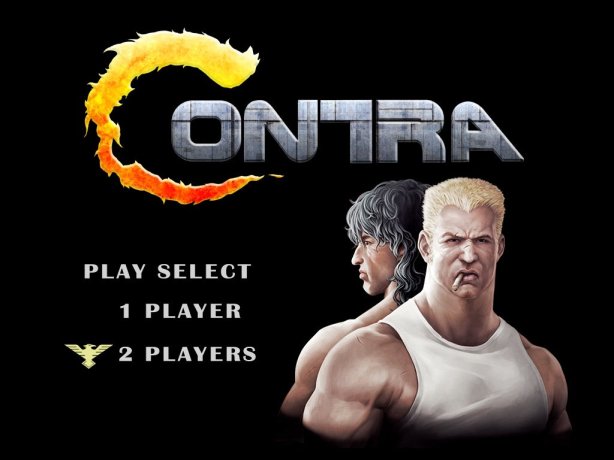
But just what is MercurySteam working on? There are some hints that it could be a new Contra game. Cox expressed interest in tackling the run-and-gun series back in 2012, even going so far as to say that MercurySteam had “an original idea” in mind. The developer’s website has, for some time, been a cryptic landing page depicting travelers in a rusty spaceship, and a countdown timer currently stands at about 27 days. We’ll presumably find out more when it hits zero.

Since the release of Lords of Shadow 2 back in 2014, MercurySteam has mostly made headlines for in-house turmoil. An anonymous former developer blamed director Enric Alvarez for the game’s quality, saying his development philosophy was “completely overlooking programmers, designers, and artists.” Alvarez told me back in February of 2014 that these were “lies and insults from an enraged ex-worker.”

What are you hoping MercurySteam tackles next? With Konami’s recent move away from traditional AAA development, perhaps we shouldn’t hold out for a Contra reboot, but then again “spiritual successors” are certainly all the rage these days!

Visit our Official Website at http://www.gamersoutpost.net


2016-03-18-image-17

by Shawn Knight via TechSpot

Sony is reportedly working on a more powerful version of its PlayStation 4 console. Dubbed the PlayStation 4.5, the new device will feature an upgraded GPU to enable 4K resolution gaming while simultaneously offering more oomph for its virtual reality platform according to multiple developer sources as first reported by Kotaku.

The publication said it wasn’t sure whether existing PlayStation 4 owners would be able to upgrade their console with the device or if it’s an entirely new console. What’s more, it’s unclear if PlayStation 4.5 will indeed be the official name of the device or if it’s just a temporary internal codename.

Today’s PlayStation 4 is capable of outputting 4K resolution pictures and videos but doesn’t have the ability to push 4K gaming.

The idea may sound a bit crazy at first but it’s much more plausible than you might think.

Modern hardware is evolving at a rapid pace and with gaming becoming more mainstream than ever and the continued threat from PC gaming, the traditional 7+ year lifecycle of a console seems incredibly unlikely. Just think, seven years ago, BlackBerry was still relevant, Palm was launching its Pre and Nokia put out the N97. The PlayStation 4 and Xbox One will be turning three later this year and compared to PC hardware, they’re already quite dated. Will they last another four years without help?

If the PlayStation 4.5 does arrive as some sort of add-on, it wouldn’t set a precedent.Remember the Sega CD and the 32X? Sure, those devices ultimately failed but one could argue that they were ahead of their time as gaming wasn’t nearly as popular as it is today.

Visit our Official Website at http://www.gamersoutpost.net

playstation-network-xbox-live

by Jacob Siegal via BGR

Earlier this week, ID@Xbox director Chris Charla seemed to imply in a post on the Xbox Wire that Microsoft would be willing to link up with Sony in order to allow for cross-network play between Xbox Live and PSN players. Of course, Charla didn’t actually mention the PlayStation 4 by name, so it only makes sense that Sony’s response would be equally cryptic.

Answering a direct question from GameSpot about the potential collaboration, Sony indicated that it would be willing to consider cross-platform play with anyone.

“PlayStation has been supporting cross-platform play between PC on several software titles starting with Final Fantasy 11 on PS2 and PC back in 2002,” Sony said in a statement to GameSpot. “We would be happy to have the conversation with any publishers or developers who are interested in cross platform play.”

That is not as clear a response as PS4 or Xbox One owners might have hoped for, but it’s a positive answer nonetheless.

It’s entirely understandable for Sony to be cautious about an arrangement that could give Xbox One owners a way to play with their PS4 friends without buying a PS4, but the fact that the technology exists (and that Microsoft is open to working together) might be enough to push them over the edge.

In the meantime, Rocket League will be the first game to support cross-network functionality on the Xbox One.

Visit our Official Website at http://www.gamersoutpost.net

fa7d0749d13339b31c958b0ddc7638de

“Halo” hero Master Chief is just as shocked as we are. (YouTube/Xbox)

by Ben Gilbert via Business Insider

Microsoft is opening up its Xbox Live online service to gamers on other platforms — namely, PlayStation 4 and PC. Whoa.

In a move that’s up there with Sonic the Hedgehog appearing next to Super Mario in a video game, Microsoft announced yesterday on its Xbox blog that it’s opening up the Xbox Live online platform — the service you use to play games online through an Xbox One or Xbox 360 — to every platform.

First, in addition to natively supporting cross-platform play between Xbox One and Windows 10 games that use Xbox Live, we’re enabling developers to support cross-network play as well. This means players on Xbox One and Windows 10 using Xbox Live will be able to play with players on different online multiplayer networks – including other console and PC networks.

That’s a huge move.

It means games like “Destiny” or “Call of Duty” could be played online, together, by players who are on Xbox One, PlayStation 4, and PC. It means Microsoft is putting the ball in Sony’s court on doing the right thing: making as many cross-platform games as possible playable across both PlayStation 4 and Xbox One.

Think about the situation right now: you buy this year’s “Call of Duty” on Xbox One, and your buddy buys it on PlayStation 4. You want to play the game online together, but you can’t. It’s the same game, with the same online modes. The only reason you can’t play the game online together is because you’re on different platforms, and the platform-makers — Sony and Microsoft — don’t allow you to play games online with people on the rival’s platform.

That’s dumb. Microsoft is saying, “We agree. That is dumb. Enough.”, and enabling game makers who are developing games for both platforms — the PlayStation 4 and the Xbox One — to allow online play across both. Rad!

c7f9334b871da3bb2786e83f6e4fe861

“Destiny” is a ridiculously popular first-person shooter on Xbox One and PlayStation 4. Players scour the universe in search of content to enjoy. (Bungie)

Considering Microsoft and Sony’s long rivalry between Xbox and PlayStation, this is a pretty major philosophical shift. It’s a smart move from a company that’s putting up a solid fight against the PlayStation 4′s continued dominance in sales (over 36 million sold). Frankly, we’re excited to see what comes of this from Sony’s side; we reached out and haven’t heard back just yet.

In the meantime, Tech Insider favorite “Rocket League” is getting cross-platform support for online play between Xbox One and PC. Bizarrely, the game already has cross-platform support between PlayStation 4 and PC, just not between all three platforms. Rather, PlayStation 4 players can play with PC players, and Xbox One players can play with PC players, but Xbox One and PlayStation 4 players can’t play together. Which is just as silly as it sounds.

Maybe “Rocket League” will be the first game in a new, consumer-first paradigm where you can simply play games with your friends regardless of what platform they bought the game on! Fingers crossed, but maybe don’t bet on it.

Visit our Official Website at http://www.gamersoutpost.net

SONY DSC

by Barbara Ortutay, Dan Goodman, and Derrik Lang via The Associated Press

NEW YORK — Nico Deyo, a 33-year-old e-commerce specialist from Milwaukee, used to enjoy mixing it up with players from around the world in the popular online fantasy game “World of Warcraft.” Then a stalker began harassing her on the game’s forums, impersonating her in the game and, later, sending her barrages of Twitter messages, some threatening her with graphic rape and murder.

While the stalker didn’t drive her from the game, the experience helped sour her on multiplayer gaming. “There’s a lot of things about the community that are very hostile,” she says of Warcraft. Deyo largely gave up the game almost two years ago and now mostly spends her time on playing other games by herself.

Deyo is far from alone. In the male-dominated world of multiplayer online games like “Grand Theft Auto,” ”Halo,” and “Call of Duty,” many women say they’ve had to take drastic steps to escape harassment, stalking and violent threats from male players. Some quit particular games. Others change their screen names or make sure they play only with friends.

Online harassment of women, often involving threats of horrific violence, has become a big issue — and video games are a frequent flashpoint. Two years ago, the online “Gamergate” movement, ostensibly a protest over the ethics of game journalists, also fueled Twitter attacks on female critics replete with gutter-level abuse and assault threats. Some targets left their homes or canceled speaking engagements, fearing for their safety.

On Saturday, the South by Southwest Interactive festival plans a daylong summit on online harassment ; one panel will address problems in “gaming and geek culture .” That summit, however, almost never happened; last October, the festival canceled two gaming-issue panels after receiving “numerous threats of on-site violence .” Organizers reversed themselves a few days later after BuzzFeed and Vox Media threatened to boycott the festival entirely.

girlgamer

Online gaming companies, however, have been slower to act. Major console makers Microsoft and Sony and game developers like Blizzard Entertainment have “terms of service” that explicitly ban stalking and other harassing behavior. The companies have the right to ban reported bad actors from their public forums. Players say that rarely happens — and when it does, as in Deyo’s case, their harassers often follow them onto Twitter and other social channels.

Becky Heineman, the 52-year-old founder of the Olde Skuul game studio in Seattle, was an aficionado of shoot-em-ups like “Halo” and “Call of Duty.” But constant catcalls from other players and questions about her bra size or “whether I do it on top or bottom, or other derogatory things,” she says, wore her down.

Reporting her harassers never seemed to make a difference, she says. She limited her play to friends for a while, but now mostly focuses on simple single-player games like “Cookie Clicker” on her phone and computer.

shutterstock_80694784

Contrary to popular stereotypes, women are avid video gamers; one recent survey showed that about half of all women play video games, about the same as men. But men are far more likely to identify themselves as “gamers,” and experts say that “hard-core” shooting and action games remain mostly male.

It’s only recently that “women players have been recognized as valid gamers that are interesting for companies,” said Yasmin Kafai, a University of Pennsylvania professor who focuses on gender and gaming.

Microsoft says recent changes to its Xbox Live service make it more likely that players with bad reputations will end up playing each other. It adds that its enforcement team monitors complaints at all times and that all reports are investigated. Sony, Blizzard and the Entertainment Software Association, a trade group, did not respond to requests for comment.

Those moves don’t impress some women in the industry.

“While they have very good statements about harassment and, you know, responsibility to the community and all that kind of stuff, the enforcement side of it is pretty lax,” says Kate Edwards, executive director of the International Game Developers Association. “Players basically have to adopt their own strategies to deal with it.”

Games and online game networks, for instance, let players “mute” messages from opponents and turn off voice chat, where trash talk can easily shade over into harassment. Xbox Live also labels players who get lots of complaints with a red marker so that other players can avoid them.

But constantly muting or reporting other players interrupts what’s supposed to be a fun pastime. And it doesn’t change harassing behavior.

“If I just block somebody, is that stopping them from doing the abuse?” says Kishonna Gray, an Eastern Kentucky University professor who wrote a book about racist and sexist interactions within Xbox. “They can go to the next person and do the same thing.”

kyle-asakura

That’s especially true when harassment shades into the real world. Mercer Smith-Looper, a 27-year-old Boston woman, found it annoying when male players patronized her and told her how to play. Then she started receiving unwanted gifts — a necklace, a sword — in the mail. One gamer unexpectedly showed up at her workplace after calling her repeatedly.

Fed up, she changed her gamer name and now sticks to playing privately with friends or alone. “I’m kind of in hiding,” she says.

What would effective anti-harassment measures look like? Experts like Edwards and Gray point to Riot Games, the maker of “League of Legends,” for its efforts to change player culture. Riot built a system based on artificial intelligence and player feedback to determine appropriate behavior during gameplay, and uses it to punish or reward players who draw complaints, according to the company’s onlinesupportdocuments .

When players show “signs of toxicity,” Riot can block them from competitive play, limit their chats or ban them entirely. The company shows players what behavior other players didn’t like when it punishes them. Jeffrey Lin, Riot’s lead game designer for social systems, has said that because of these efforts, only 2 percent of its global games experienced racist, homophobic, sexist language or excessive harassment.

Riot Games declined to comment when contacted by The Associated Press.

IGDA’s Edwards acknowledges that dealing with harassment is a difficult challenge. “You’re dealing with minors versus adults,” she says. “You’re dealing with free speech issues. It’s a struggle for companies to figure out exactly how to approach it.”

And while Riot-style moderation might limit harassment, it’s unlikely to solve the problem on its own. “This is a social and cultural problem, not a technological one,” says Dmitri Williams, CEO of game analytics firm Ninja Metrics.

Visit our Official Website at http://www.gamersoutpost.net
TCTD_screenshot_team_street_encounter_011516_7amPT_1455824969-1200x675

by Dave Thier via Forbes

In many ways, The Division feels like the game Ubisoft has been practicing to make for years. Everything that we’ve seen in other games is here: the open world side mission structure, crafting, a story mission that weaves its way through exploration and progression — etc. It’s the sort of thing that lends itself well to the MMO format that the developer is now testing out, but not everything necessarily translates. After a few days with The Division I’ve plunged my way into a New York shattered by a smallpox epidemic, I’ve mowed down hordes of countless enemies and a bunch of other people I’m pretty sure were bad, and I’ve begun upgrading my weapons and creating what feels like a customized agent. I’ve also got some skinny jeans. There are plusses and minuses to the whole thing.

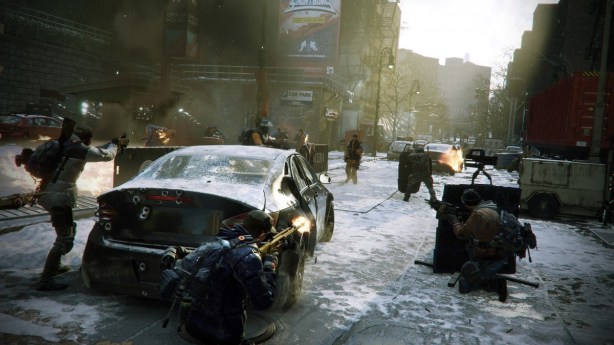
The Good: The Division feels grounded. The 1:1 recreation of Manhattan is one of the best I’v ever seen in a video game, and that’s only enhanced by the way your character moves through it. Your agent slams into cover with a sense of weight, climbs up onto ledges with the feeling that he or she is actually doing a pull up, and dashes from the back of a car to a traffic barrier with urgency and grace. It’s a pretty game, and it offers up its nightmare versions of familiar landscapes little by little, unfolding more and more of the story as it goes. On top of that, the squad mechanics and environments are fantastic. This is a deeply tactical game, and it only gets more so the more skills you and your group members acquire. Every area I’ve been in has multiple avenues of attack, multiple ways of approaching the same group of enemies, and excellent opportunities for cooperation when it comes to taking down high-level enemies. There’s a real sense of satisfaction that comes with a successful flanking maneuver or a well-placed turret, and that speaks to how well some of these encounters are designed.

It all comes to a head in The Dark Zone, Ubisoft’s blended PvE, PvP environment that stands head and shoulders above the rest of the game. There’s a real sense of danger in there from NPCs, other agents, and even your own teammates. And the fact that you have to call in a helicopter to extract any loot found in there lends a superb sense of structure to a jaunt to the Dark Zone. It’s a striking transition when you cross over that wall: all of a sudden you sit forward, your fingers arch, and you activate in a way that the rest of the game doesn’t quite ask you to do. My only complain is that I can’t spend all my time in there.

The Bad: So far, things are a bit of a grind. In some ways, it’s a similar situation as with the earlier parts of Bungie’s Destiny, but without those ultra-satisfying shooter mechanics to keep you on an endless dopamine loop. I found myself grinding out some fairly repetitive side missions just a few hours in: that may have been fine for an MMO ten years ago, but neither myself nor the market at large has as much patience for grinding as we once did. The gameplay works, but the shooting lacks that tactility that makes navigation such a joy. Even low level enemies have a way of absorbing a whole mess of bullets before going down, and you never quite get the feeling that your shots are making much of an impact. Armored enemies are even worse. More than one engagement I’ve found myself in has resulted in finding a safe spot and just slowly picking off small moments of health before retreating, healing, and waiting. That’s not a good place to be in.

The story is fine, but not remarkable enough to fall into either a good or a bad category: it’s there, with one faction of interesting enemies, a few passable characters, and more deep New York accents than you can shake a stick at. There’s a real troubling moral ambiguity about what you’re doing: trying to fix the world by shooting anyone and everyone, and that wears on you after a little bit. All in all, I just don’t always feel that drive to move forward that I get even from other Ubisoft games. There’s a plod here, which slows you down.

The Bleak: Things have been better for New York. while the worlds in which we gamers clomp around killing computer controlled enemies are never exactly friendly, there’s something particularly depressing about this one. Part of it is the weather: so far, New York is caught in a perpetual winter, with the streets covered in snow and rarely more than that a slightly brighter version of overcast to mark the daytime. Things are cold, people are desperate, and it’s starting to wear on me. That feeling is exacerbated by the relatively constrained environments. We’re in Manhattan, and only a small part of it at that. Unlike other RPGs, there are no verdant forests or parched desserts to be discovered. Instead, we’re trapped in a relatively sameish environment, shooting the same enemies with upgraded versions of the same guns. That’s my main worry about the game so far: that Ubisoft is going to be able to give me that sense of wonder and excitement that needs to come with MMO expansion content. Part of that will be well solved by just melting the snow and moving on to winter. Or maybe we’ll just be able to go to Grand Central and hop on Metro North.

And that’s where we are now: a solid beginning, but one that worries me about its ability to keep me interested in the face of higher-energy games. Those are my initial impressions, and I’ve put enough time into the game to get a sense of what it is. Still, I’ll keep playing, and the changing nature of an MMO means that there’s bound to be plenty more to see, so check back.

Visit our Official Website at http://www.gamersoutpost.net